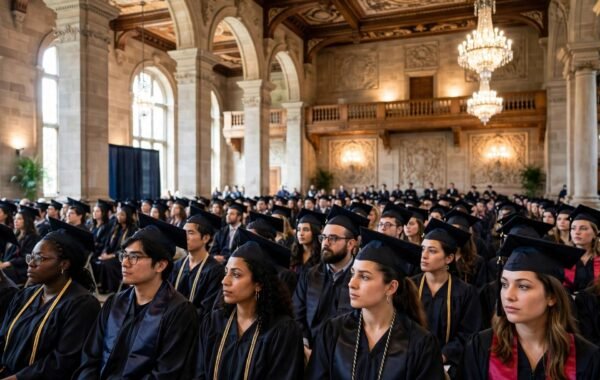
Every year, admissions tutors read thousands of personal statements, and most blur into a single voice: passionate about my subject since childhood, fascinated by the world around me, looking forward to the challenge. The students who stand out are not more impressive people. They are more specific writers.
This guide covers the structure that works, opening lines that hook instead of sedate, and the specificity trick that separates memorable statements from forgettable ones, all updated for the current UCAS format.
The Structure That Works: 70-20-10
Forget the old 80-20 academic-to-extracurricular split; the working formula is roughly 70 per cent academic engagement, 20 per cent relevant experience and skills, and 10 per cent personal colour. The academic core must show thinking, not just enthusiasm: what you have read, watched, built or debated beyond the syllabus, and what you made of it.
The classic UCAS structure, now in its structured-question format, still rewards the same arc: why this subject, evidenced by what you have done; what you have learned from experiences; and where it points next. Write it as an argument, not a list. Every paragraph should answer the tutor's silent question: does this person think like someone who will thrive in our department?
Openings That Hook (and the Clichés to Bury)
Tutors decide within seconds whether a statement will be interesting, and most openings fail the test. Bury these: I have always been passionate about, from a young age I have been fascinated by, and any quotation from a famous figure. They signal a statement written from templates, and tutors have read the templates.
Strong openings are specific and slightly unexpected: a moment, a puzzle, a contradiction. The hospital waiting room where I watched triage decisions made me want to understand resource allocation became an economics statement's hook. A failed sourdough starter taught me more about experimental method than any textbook anchored a biology one. Start with the concrete, then widen to the subject. Specificity is interesting; generality is wallpaper.
The Specificity Trick: Show the Thinking, Not the Trophy
Here is the technique that transforms statements: for every claim, add the thought it produced. Not I volunteered at a care home, but volunteering at a care home showed me how dementia reshapes identity, which made me question what person-centred care actually requires. Not I enjoy debating, but losing a debate on prison reform forced me to rebuild my argument from evidence rather than instinct.
This works because tutors are selecting for minds, not CVs. A modest experience reflected on deeply beats an impressive experience described flatly. It also protects against the exaggeration trap: you do not need dramatic experiences when ordinary ones, examined honestly, reveal genuine intellectual curiosity. Write what you actually thought, not what you think sounds impressive.
Evidence Beats Adjectives, Every Time
Passionate, dedicated, enthusiastic, fascinated: these words appear in most statements and prove nothing. Delete every adjective about yourself and replace it with evidence. Instead of I am a committed reader of history, write: over the past year I have worked through three contrasting accounts of the English Civil War and found myself siding with the revisionists on causation.
The same applies to skills. Do not claim leadership, teamwork or resilience in the abstract; attach each to a concrete episode with an outcome. Captaining the debate team to the regional final is evidence. I am a natural leader is noise. And be honest about AI assistance: using AI to help write your CV notwithstanding, tutors increasingly check for AI-generated statements, and a generic, polished, soulless statement is now a red flag rather than an asset. Choosing well matters more than ever given whether AI will make university degrees less valuable.
Drafting, Feedback and the Final Polish
Write the terrible first draft fast, without editing, aiming for raw material rather than prose. Then cut ruthlessly: the 4,000-character limit, across UCAS's three structured questions, forces economy, and every sentence must earn its place. Read it aloud; clunky phrasing reveals itself to the ear.
Get feedback from a teacher who knows the subject, not just English teachers checking grammar. Ask them the killer question: does this sound like me, and does it show thinking? Then leave it for 48 hours and re-read cold. The final polish is about authenticity as much as accuracy: a statement that sounds like a real, curious, thoughtful seventeen-year-old will always beat one that sounds like a committee. UCAS personal statement guidance offers official structural guidance, and Prospects shows where strong statements lead.
The UCAS Format: What Changed and What It Means
UCAS replaced the single 4,000-character personal statement with three structured questions, and the change rewards a different kind of writing. The questions ask why you want to study the subject, how your experiences prepare you, and what else makes you suitable, which means the old trick of burying weak academic engagement under extracurricular padding no longer works. Each question demands its own direct answer, and tutors read them looking for specific evidence rather than flowing prose.
The practical implications: prepare bullet-point evidence for each question separately before drafting, since the structure punishes the old single-narrative approach. The motivation question wants intellectual specifics, books, lectures, puzzles, not childhood anecdotes. The preparation question wants experiences with reflection attached. The suitability question is where work, volunteering and personal qualities belong, but still tied to what they taught you. Character limits per question force even tighter economy than before. The students who thrive under the new format are the organised ones: evidence filed by question, drafted separately, then polished. The format changed; the underlying test, can you show a mind engaged with the subject, did not.
Key Takeaways
Memorable personal statements run on specificity, not superlatives: open with a concrete moment rather than a lifelong-passion cliché, replace every adjective about yourself with evidence, and attach reflection to every experience you mention. Structure around the 70-20-10 split of academic engagement, relevant experience and personal colour, and adapt to UCAS's three structured questions. Draft fast, cut ruthlessly to the character limit, get subject-teacher feedback, and re-read cold after 48 hours. Never submit AI-generated generic prose; tutors now read it as a red flag.
A personal statement stands out through specificity, not superlatives: a concrete opening, evidence instead of adjectives, reflection attached to every experience, and an honest voice. Tutors read thousands of statements; the ones they remember are the ones that show a mind at work. Write yours as an argument for why you belong in that department, and let the evidence do the impressing.
Frequently Asked Questions
How long should a UCAS personal statement be?
UCAS now uses three structured questions with 4,000 characters total including spaces, roughly 500 to 600 words. Every sentence must earn its place, so draft long and cut hard.
What should I avoid in a personal statement?
Clichéd openings about lifelong passion, famous quotations, lists without reflection, exaggerated claims, and AI-generated generic prose. Tutors spot all of these instantly.
Can I mention extracurriculars unrelated to my subject?
Briefly, if they demonstrate transferable skills with concrete evidence. But the statement's core must be academic engagement with your chosen subject: reading, projects, and thinking beyond the syllabus.
Should I write different statements for different universities?
You submit one statement to all five UCAS choices, so it must work for all of them. Choose closely related courses, or pitch the statement at the common academic ground between them.