Hurricanes are the most powerful storms on Earth — a single large hurricane releases energy equivalent to thousands of nuclear bombs, yet it begins as nothing more dramatic than a cluster of thunderstorms over warm ocean water. Understanding how hurricanes form, step by step, turns them from terrifying mysteries into comprehensible physics. And while Britain does not get true hurricanes, their remnants regularly reach us as powerful autumn storms, so the science is closer to home than you might think.
This guide walks through hurricane formation from warm water to monster storm, explains why they spin, and clarifies what happens when they reach land — including the UK.
Step 1: Warm Ocean Water — The Fuel
Everything starts with heat. Hurricanes need sea surface temperatures of at least 26.5°C (about 80°F), typically in the tropical Atlantic, Caribbean, or eastern Pacific during late summer and autumn. Warm water evaporates rapidly, loading the air above it with moisture and heat energy — the fuel the entire storm will run on.
This is why hurricane season peaks in September: ocean temperatures lag behind summer air temperatures, reaching their maximum just as autumn begins. It is also why climate scientists watch ocean warming so closely — warmer seas mean more fuel, and the Met Office’s climate change guidance notes the link between warming oceans and more intense tropical cyclones.
Step 2: Rising Air and the Thunderstorm Cluster
Warm, moist air is less dense than the cooler air around it, so it rises. As it rises, it cools, and the water vapour condenses into clouds — releasing latent heat, which warms the surrounding air and makes it rise even faster. This self-reinforcing loop is the engine of every thunderstorm.
A hurricane begins as an ordinary cluster of thunderstorms. What transforms it from a passing storm into something organised is the next ingredient: converging winds at the surface feed more warm, moist air into the system, while diverging winds high in the atmosphere vent the rising air away — like a chimney drawing smoke upward. When inflow at the bottom and outflow at the top balance, the system can sustain and intensify itself.
Step 3: Spin — Why Hurricanes Rotate
The spin comes from Earth’s rotation via the Coriolis effect. As air rushes toward the low-pressure centre, Earth’s rotation deflects it — to the right in the Northern Hemisphere — causing the whole system to rotate counterclockwise (clockwise in the Southern Hemisphere). This is why hurricanes never form within about 5 degrees of the equator: there is not enough Coriolis deflection there to get the spin started.
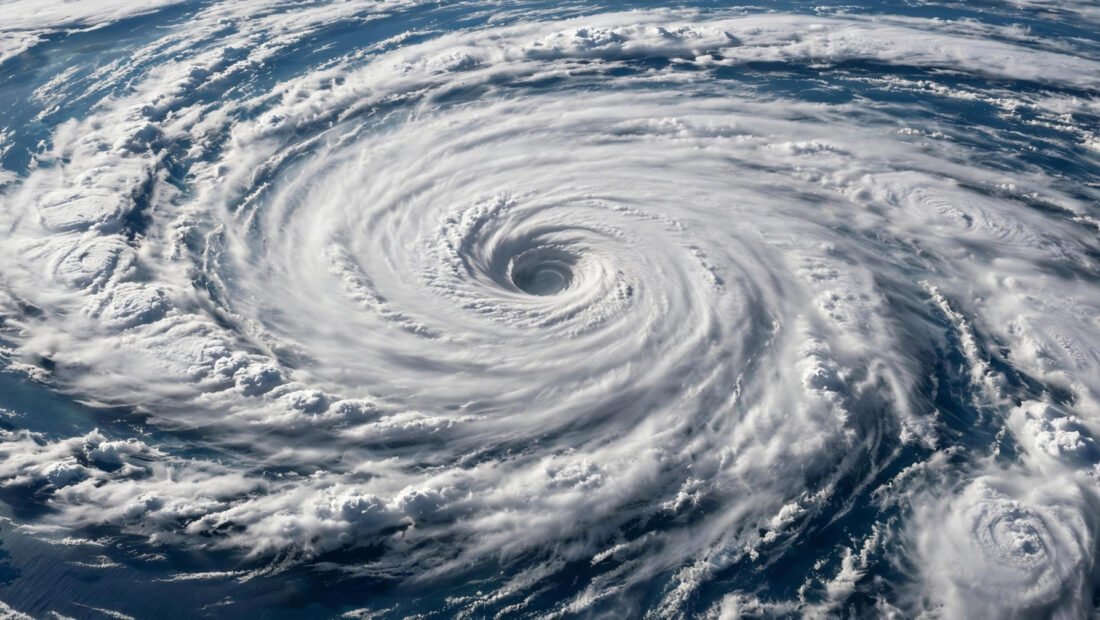
As the rotation tightens, conservation of angular momentum — the same physics as a figure skater pulling in their arms — makes the winds spin faster and faster. Wind speeds climb from tropical depression (under 39 mph) to tropical storm (39–73 mph) to hurricane (74 mph and above). The centre becomes the famous eye: a calm, clear zone where air sinks rather than rises, surrounded by the eyewall — the ring of most violent winds and heaviest rain.
Step 4: The Mature Hurricane — A Heat Engine
A mature hurricane is essentially a colossal heat engine, converting the thermal energy of warm ocean water into wind. It is remarkably structured: spiral rainbands feeding moisture inward, the eyewall generating the fiercest winds, and upper-level outflow venting exhaust. A large hurricane can be 500 miles across and persist for two weeks, travelling thousands of miles while dumping trillions of gallons of rain.
The Saffir-Simpson scale categorises hurricanes by sustained wind speed, from Category 1 (74–95 mph) to Category 5 (157+ mph). But wind is only one killer — storm surge (the sea pushed ashore by the storm) and inland flooding from rainfall cause most deaths. Understanding this matters for interpreting news coverage: a “weakening” Category 4 dropping to Category 2 can still be catastrophic if it stalls over land and rains for days.
Step 5: Landfall and Death — What Kills a Hurricane
Hurricanes die when cut off from their fuel. Moving over land removes the warm-water energy source, and friction with terrain disrupts the circulation — which is why hurricanes weaken rapidly after landfall even as their rain and surge do the worst damage. Moving over cooler water has the same effect.
What reaches Britain is not a hurricane but its remnant: an ex-hurricane transitioning into an ordinary (if powerful) mid-latitude storm. These systems still pack hurricane-force gusts and enormous rainfall — storms like the remnants of Ophelia (2017) brought genuine disruption to the UK and Ireland, with Cornwall and the south-west often first in line. The Met Office weather warnings are the authority to watch when such systems approach — worth checking before visiting Cornwall in October, peak season for these Atlantic leftovers — and our guide to travelling sustainably touches on how climate-aware travel is becoming mainstream.
Hurricanes vs Typhoons vs Cyclones: The Same Storm, Three Names
Here is a fact that confuses everyone: hurricanes, typhoons, and cyclones are the same phenomenon — tropical cyclones — with different regional names. Hurricanes form in the Atlantic and north-eastern Pacific, typhoons in the north-western Pacific (affecting Japan, the Philippines, and China), and cyclones in the South Pacific and Indian Ocean. The physics is identical; only the address changes.
The naming conventions differ too: Atlantic hurricanes get human names from rotating lists (which is why you hear them on the news), and particularly devastating names are retired — Katrina, Sandy, and Maria will never be reused. The Southern Hemisphere season runs roughly opposite to the Northern one (November to April), because it follows the southern summer’s warm oceans. So when you read about a “super typhoon” hitting the Philippines and a “hurricane” approaching Florida in the same week, you are reading about sibling storms born of the same warm-water physics on opposite sides of the planet.
Conclusion: From Warm Water to Monster, Step by Step
Hurricanes form through a chain anyone can follow: warm ocean water evaporates and fuels rising air; converging winds organise thunderstorms into a rotating system; Earth’s spin sets the rotation; the heat engine intensifies into the eyewall structure; and landfall or cold water finally starves it of fuel. No mystery, no magic — just physics operating at planetary scale. And the next time an ex-hurricane’s remnants lash Britain in October, you will know exactly what journey that storm has been on.
Frequently Asked Questions
How do hurricanes form step by step?
Warm ocean water (26.5°C+) evaporates and fuels rising air; converging surface winds organise thunderstorms into a rotating system; the Coriolis effect sets the spin; the heat engine intensifies into an eyewall structure; landfall or cold water eventually kills it.
Why do hurricanes spin?
Earth’s rotation deflects inflowing air via the Coriolis effect, starting a rotation that tightens and accelerates like a spinning figure skater pulling in their arms. Counterclockwise in the Northern Hemisphere, clockwise in the Southern.
Can hurricanes hit the UK?
True hurricanes cannot — our waters are too cold to sustain them. But ex-hurricanes regularly reach Britain as powerful mid-latitude storms with damaging winds and heavy rain, most often in autumn.
What is the eye of a hurricane?
The calm, clear centre where air sinks instead of rising, typically 20–40 miles across. It is surrounded by the eyewall, the ring of the storm’s most violent winds — which is why the calm is temporary and deceptive.