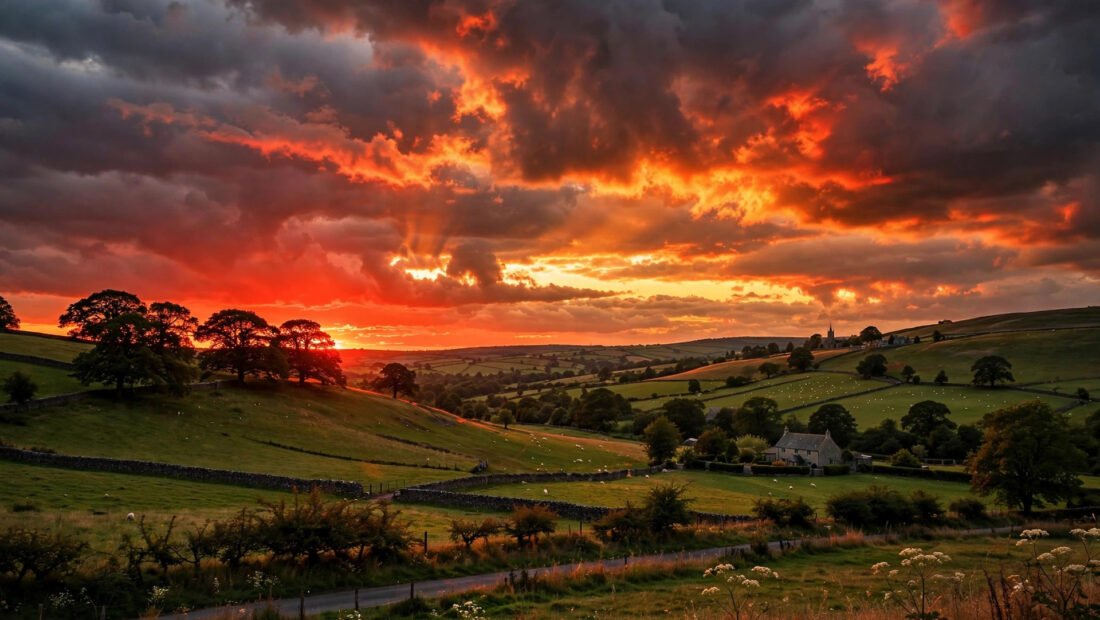
Some evenings the western sky catches fire — bands of orange, pink and crimson that stop people mid-step. Other evenings it just… gets dark. The difference is not magic or pollution alone; it is physics playing out in the atmosphere above you, and once you understand it, you can even predict the spectacular sunsets before they happen.
This guide explains why the sky turns red at sunset from absolute scratch: the scattering of light, why noon looks different, and what makes some sunsets unforgettable.
The Short Answer: Light Takes a Longer Path
Sunlight looks white, but it is a mix of all colours. When it enters the atmosphere, air molecules scatter the light — and they scatter blue light far more strongly than red (a phenomenon called Rayleigh scattering, after Lord Rayleigh who described it in the 19th century). At midday, the Sun is overhead: light takes the shortest path through the atmosphere, blue scatters everywhere (which is why the daytime sky is blue), and the Sun looks white-yellow.
At sunset, the Sun is near the horizon: its light travels through far more atmosphere to reach your eyes — up to 40 times more air than at noon. Along that long path, almost all the blue light scatters away, leaving the reds, oranges and pinks to dominate. The redder the sunset, the longer the path and the more scattering has occurred. That is the whole mechanism — everything else is detail.
Why Some Sunsets Are Spectacular (and Others Are Not)
Particles help — up to a point
Tiny particles in the air (dust, salt, pollution, volcanic aerosols) enhance scattering and deepen the colours. This is why sunsets after volcanic eruptions can be extraordinary worldwide — Krakatoa’s 1883 eruption produced vivid sunsets for years, famously painted by Munch in “The Scream.” But heavy pollution or thick haze washes sunsets out rather than enhancing them; the sweet spot is light aerosols, not smog.
Clouds are the canvas
The most dramatic sunsets need mid- and high-level clouds (altocumulus, cirrus) to catch the coloured light — a completely clear sky gives a pleasant glow but no drama, while full low cloud blocks the Sun entirely. The classic recipe: a day with broken cloud that partially clears at the western horizon around sunset, letting low sunlight hit the cloud undersides.
Humidity and air quality
Clean, dry air after a cold front often produces the crispest colours; humid, hazy air mutes them. Autumn and winter frequently deliver the UK’s best sunsets — lower Sun angles, cleaner air, and more interesting cloud. The Met Office forecast (cloud cover and air quality) is genuinely useful for sunset prediction.
The Folklore: “Red Sky at Night…”
“Red sky at night, shepherd’s delight; red sky in the morning, shepherd’s warning” is real meteorology in folk dress. In the UK, weather systems generally move west to east. A red sunset means the setting Sun is illuminating clouds to the west — but the western sky near the Sun is clear enough for the light to get through, suggesting high pressure and settled weather approaching from the west: fine tomorrow. A red sunrise means the red light is scattering through clouds to the east — weather systems heading your way: rain likely. It is not infallible, but the physics behind the saying is sound.
Sunsets Elsewhere: Mars and Beyond
The same physics, different atmospheres, different colours. On Mars, sunsets are blue: the thin, dusty Martian atmosphere scatters red light away and lets blue through near the Sun — the exact inverse of Earth’s, photographed by NASA’s rovers. It is a beautiful demonstration that sunset colours are not a property of the Sun but of the air in between. Underwater, at altitude, on other worlds — change the atmosphere, change the sunset.
The green flash
On rare, clear evenings, the last sliver of the setting Sun can flash green for a second — caused by the atmosphere refracting (bending) sunlight like a prism, separating the colours at the Sun’s edge. It needs a distant, flat horizon (the sea is ideal) and clean air. Watch the exact moment of sunset; blink and you miss it. The Royal Observatory Greenwich explains atmospheric optics beautifully, and the BBC covers the science accessibly.
Why Sunsets Beat Sunrises (Usually)
Sunrises and sunsets involve identical physics — yet sunsets are statistically more colourful. The reason is what the day has done to the air: by evening, convection, traffic, industry and wind have lofted particles and moisture into the atmosphere, providing the aerosols that enhance scattering. Overnight, particles settle and the air cleans itself, so dawn light passes through clearer, less interesting air.
There is also a human factor: more people watch sunsets, so more spectacular sunsets get noticed and photographed — a mild observation bias. But dedicated dawn-watchers confirm the pattern: all else equal, evening wins. The exception is after stormy nights, when the cleared, washed air can produce exceptionally crisp dawn colour. Either way, the Met Office cloud forecast is your planning tool for both.
Do not leave at sunset — stay for the afterglow
Most people pack up when the Sun disappears. Mistake. The 20–40 minutes after sunset — the afterglow, or “second sunset” — often produces the deepest pinks and purples as high clouds catch light from the already-set Sun. Photographers call this the blue hour’s warm cousin, and it is frequently more beautiful than the sunset itself. Similarly, arriving 30 minutes before sunset lets you watch the light evolve. The full show runs about an hour; most people watch ten minutes of it.
Photographing Sunsets: Catching the Colours
Phone cameras often dull sunsets — they auto-expose for the bright sky and wash out the colour. Tap to focus on the brightest part of the sky (not the Sun itself), then drag the exposure down slightly; shoot in the minutes after the Sun dips below the horizon (the “afterglow” is often more colourful than sunset itself); include foreground silhouettes for depth; and clean your lens (a greasy lens murders sunset photos). For editing, resist cranking saturation to neon — nudge warmth and vibrance gently. See our guide to the best AI tools for editing photos on a phone for apps that handle this well. And if atmospheric light-shows captivate you, the ultimate one is the aurora — see seeing the northern lights in the UK.
Conclusion
The sky is red at sunset because sunlight takes a long, low path through the atmosphere, and air molecules scatter away the blue light (Rayleigh scattering), leaving reds and oranges. Spectacular sunsets need the right ingredients: light aerosols, mid-level clouds as a canvas, and clean air — which is why you can partly predict them from the forecast. The same physics explains blue daytime skies, the shepherd’s-delight folklore, and even blue sunsets on Mars.
Frequently Asked Questions
Why is the sky blue during the day but red at sunset?
Both are Rayleigh scattering. At midday, sunlight’s short atmospheric path scatters blue light across the sky. At sunset, the much longer path scatters away nearly all blue, leaving red and orange.
Does pollution make sunsets more beautiful?
Light aerosols can enhance colours, but heavy pollution washes sunsets out. The most vivid sunsets come from clean air with the right clouds — not smog.
What is the green flash at sunset?
A brief green flash as the Sun’s last sliver sets, caused by atmospheric refraction separating sunlight’s colours. It needs a clear, flat horizon (ideally the sea) and clean air.
Why are winter sunsets often more colourful in the UK?
Lower Sun angles mean longer atmospheric paths, colder air is often cleaner with less haze, and winter brings more of the broken mid-level cloud that catches the colours.