Under your feet right now, tens of kilometres down, rock is hot enough to flow. Most of the time it stays put. But where the Earth’s crust is cracked or thin, that molten rock finds a way up — and the result is a volcano: the planet’s pressure valve, landscape architect and occasional catastrophe, all in one. Understanding what happens inside one takes less time than you think, because the core story is beautifully simple.
This guide explains volcanoes from scratch: what is happening underground, why eruptions differ so dramatically, the main volcano types, and Britain’s own volcanic past.
The Engine Room: Magma Chambers
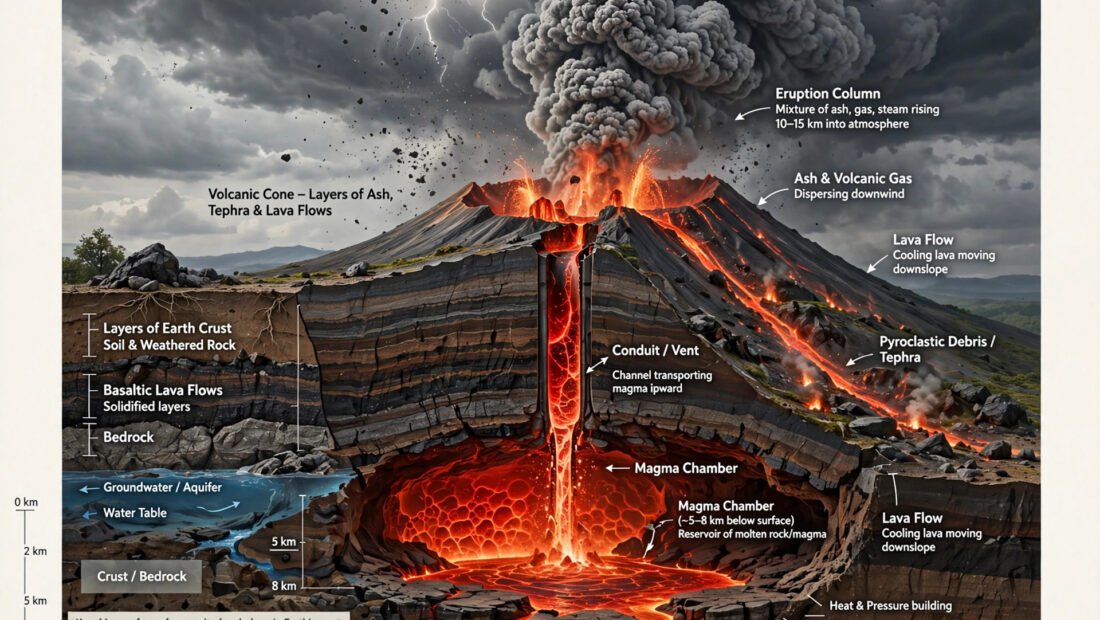
Deep beneath a volcano sits a magma chamber — a reservoir of molten rock (magma is the underground name; once erupted it is called lava), typically 5–20km down. Magma forms where the mantle melts: at tectonic plate boundaries pulling apart or colliding, and at “hotspots” where plumes of hot mantle rise (Hawaii, Iceland). The chamber fills slowly over years to millennia, pressurising as fresh magma arrives.
The critical ingredient is gas — mostly water vapour and carbon dioxide dissolved in the magma under pressure, like fizz in a sealed bottle of pop. As magma rises, pressure drops, the gas comes out of solution, and bubbles form and expand. This is what drives eruptions: the difference between a gentle lava flow and a cataclysmic explosion is largely about how much gas is trapped and how sticky (viscous) the magma is. Low-viscosity, low-gas magma flows; high-viscosity, gas-rich magma explodes.
Why Eruptions Differ: The Viscosity Story
Magma chemistry — specifically silica content — controls everything. Runny basaltic magma (low silica, like Hawaii’s) lets gas escape easily: eruptions are effusive, producing spectacular lava fountains and rivers of lava that you can (carefully) walk near. Sticky rhyolitic magma (high silica, like Mount St Helens or Vesuvius) traps gas until pressure overcomes it: eruptions are explosive, shattering magma into ash and launching eruption columns kilometres high, sometimes collapsing into pyroclastic flows — superheated avalanches of gas and rock that move at hundreds of km/h and destroy everything in their path.
Between the extremes sit volcanoes like Etna and Stromboli: regular, moderate eruptions, lava fountains, manageable ash. Volcanologists classify eruptions on a scale (the Volcanic Explosivity Index, VEI 0–8) from gentle Hawaiian flows to super-eruptions like Yellowstone’s ancient blasts — the latter capable of global climate effects. The US Geological Survey maintains superb explainers on eruption styles.
The Main Volcano Types
Shield volcanoes
Broad, gentle domes built by countless runny lava flows — Hawaii’s Mauna Loa is the archetype, and the largest volcano on Earth by volume. Eruptions are frequent but usually non-explosive.
Stratovolcanoes (composite volcanoes)
The classic cone: alternating layers of lava and ash from mixed eruption styles. Etna, Vesuvius, Fuji, St Helens. Beautiful, dangerous, and responsible for most history-changing eruptions.
Cinder cones
Small, steep piles of volcanic cinders from single eruptive episodes — Parícutin in Mexico famously grew from a cornfield to a 400m cone in under a decade starting in 1943.
Calderas and supervolcanoes
When a massive eruption empties the magma chamber, the ground collapses into a vast crater — a caldera. Yellowstone and Campi Flegrei (near Naples, currently restless and closely monitored) are the famous examples. These are the volcanoes that change climates.
Britain’s Volcanic Past (Yes, Really)
Britain has no active volcanoes — but it is built on dead ones. Around 400 million years ago, much of what is now Britain sat near tectonic plate boundaries with serious volcanic activity. Arthur’s Seat in Edinburgh is the eroded remnant of a Carboniferous volcano; the Lake District’s Borrowdale Volcanics and Snowdonia’s ranges are ancient volcanic rock; the Giant’s Causeway’s hexagonal columns are 60-million-year-old basalt from the same volcanic episode that opened the North Atlantic.
Could it happen again? Not on human timescales — Britain sits in the middle of a tectonic plate now, far from active boundaries. The nearest active volcanism is Iceland, which is why Eyjafjallajökull’s 2010 ash cloud grounded UK flights: a reminder that volcanoes elsewhere still reach us. The British Geological Survey documents the UK’s volcanic heritage in detail, and the BBC covers volcanic science accessibly.
Eruptions That Changed History
A few eruptions illustrate the science vividly. Vesuvius, AD 79: a stratovolcano’s explosive eruption buried Pompeii and Herculaneum under ash and pyroclastic flows, preserving a Roman city — and demonstrating pyroclastic flows’ lethality. Tambora, 1815: the largest eruption in recorded history (VEI 7), which caused the “Year Without a Summer” in 1816 — global temperatures dropped, crops failed across Europe and North America, and Mary Shelley wrote Frankenstein during that dark, stormy Geneva summer. Krakatoa, 1883: its explosion was heard 3,000 miles away and its aerosols coloured sunsets worldwide for years.
More recently: Mount St Helens, 1980 — the lateral blast flattened 600 square kilometres of forest and taught volcanologists how gas-rich magma behaves catastrophically; Eyjafjallajökull, 2010 — a modest Icelandic eruption whose fine ash, carried by the jet stream over Europe, grounded 100,000 flights and cost airlines £1.3 billion, showing that eruption impact depends on location and wind as much as size; and Hunga Tonga, 2022 — an underwater eruption that sent a shockwave around the planet and the highest ash plume ever recorded. Each one refined the science — and the monitoring that now watches restless volcanoes like Campi Flegrei around the clock. The British Geological Survey and USGS both maintain superb eruption histories.
Seeing Volcanoes Yourself
Volcano tourism is real and spectacular: Etna and Stromboli (guided ascents, best May–October), Iceland’s volcanic landscapes (where you can walk between tectonic plates and, in active phases, see fresh lava fields), and the Azores, Santorini and Tenerife for gentler volcanic scenery. Go with guides, respect exclusion zones — volcanoes injure tourists every year, usually through ignored warnings — and check travel advice before booking. If you are planning a trip, see our guides to seeing the northern lights in the UK (Iceland pairs volcanoes with aurora beautifully) and finding cheaper flights to get there affordably.
Conclusion
Inside a volcano, a magma chamber pressurises as gas-rich molten rock accumulates; when pressure overcomes the rock above, eruption follows — gentle flows if the magma is runny, explosions if it is sticky and gassy. That single mechanism, varied by chemistry and setting, produces everything from Hawaiian lava fountains to civilisation-shaking super-eruptions. Britain’s own volcanoes are long dead but visible in Edinburgh, the Lakes and the Giant’s Causeway — geology you can walk on.
Frequently Asked Questions
What is the difference between magma and lava?
Magma is molten rock underground; lava is magma that has erupted onto the surface. Same material, different location — the name changes at the vent.
Can scientists predict volcanic eruptions?
Partially. Monitoring (earthquake swarms, ground deformation, gas emissions) gives warnings of days to weeks for many volcanoes, but exact timing and size remain unpredictable. Prediction is improving steadily.
Is Yellowstone going to erupt?
Not imminently by any scientific assessment — the USGS puts the annual probability of a major eruption at around 1 in 730,000. It is intensely monitored, and smaller hydrothermal events are far more likely than a super-eruption.
Are there any active volcanoes in the UK?
No. Britain’s volcanoes died hundreds of millions of years ago. The UK’s volcanic rocks (Arthur’s Seat, the Lake District fells, the Giant’s Causeway) are eroded remnants, not active systems.