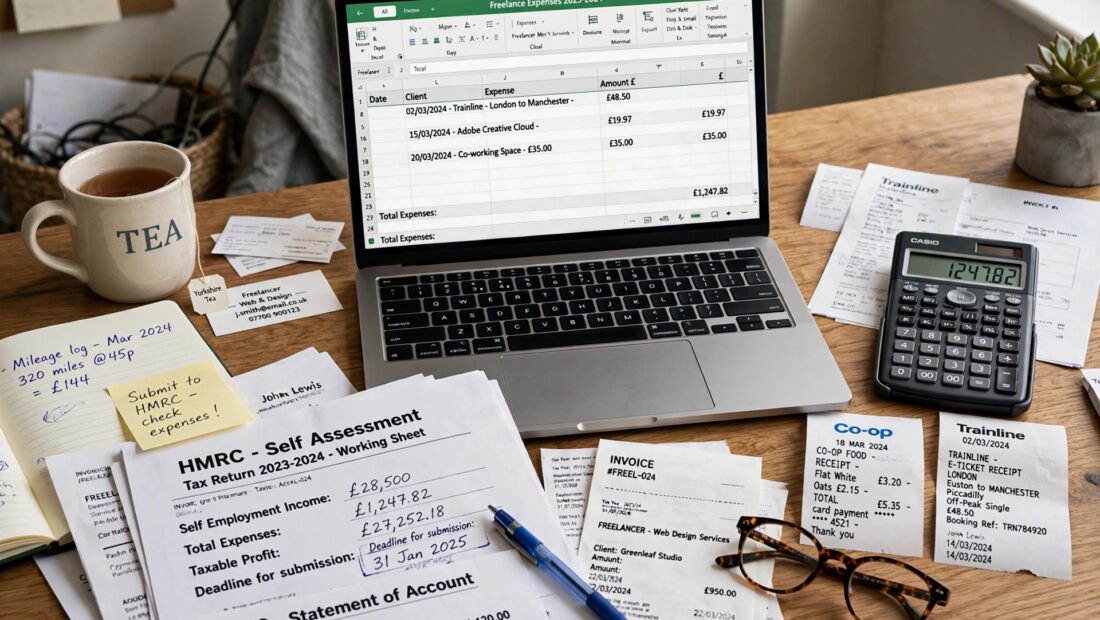
Your first freelance invoice feels like pure victory — until someone mentions that roughly 20–40% of it belongs to HMRC and you have been spending it. Freelance taxes confuse every beginner because employed life hid the machinery: your employer handled PAYE, National Insurance and pensions silently. As a freelancer, you are the machinery. The good news: the system is logical once explained, and this guide explains all of it from absolute zero.
Step 1: Register as Self-Employed
If you earn over £1,000 from self-employment in a tax year (the trading allowance), you must register with HMRC as self-employed — ideally soon after starting, and no later than 5 October following the tax year you started in. Registration is free and done online; HMRC then sends you a Unique Taxpayer Reference (UTR), which you need for Self Assessment.
The £1,000 trading allowance is genuinely useful: earn under £1,000 from odd freelance gigs and you neither register nor report it. Cross £1,000 and the full machinery applies. Note the choice this creates: below £1,000, simplest to stay unregistered; above it, register and claim actual expenses (which usually beats the allowance). GOV.UK’s working-for-yourself pages walk through registration step by step.
What You Actually Pay
Income Tax
Freelancers pay Income Tax on profits (income minus allowable expenses), not on turnover — the distinction that saves beginners thousands. Rates for 2026/27: 20% basic rate above the £12,570 personal allowance up to £50,270, 40% above that, 45% above £125,140. Your freelance profit stacks on top of any employed income for band purposes.
National Insurance
Self-employed NI (Class 2 and Class 4) applies to profits above thresholds — Class 4 at 6% on profits between £12,570 and £50,270, 2% above. The rules have been simplified in recent years; check current rates on GOV.UK when filing, as thresholds move.
The 30% rule of thumb
Until you know your exact liability, put aside 25–30% of every invoice into a separate savings account the day you are paid. This single habit prevents the classic beginner catastrophe: a £8,000 tax bill arriving with £400 in the bank. Open a second bank account (a free savings account works) and transfer immediately — money you never see, you never spend.
Allowable Expenses: The Beginner’s Goldmine
Every legitimate business cost reduces your taxable profit. Common beginner expenses: home office costs (a flat-rate simplified allowance or proportion of actual bills), equipment (laptop, phone, software), professional subscriptions, training directly related to your work, travel to clients (not regular commuting to one workplace — that is disallowed), marketing and website costs, accountancy fees, and a proportion of phone and internet bills.
Keep receipts for everything — digital photos are fine — and track from day one. Free tools exist specifically for this: see our guide to the best free accounting software for UK freelancers. The test HMRC applies is “wholly and exclusively” for the business; be honest, be consistent, and when in doubt, an accountant’s one-off advice call (£100–£200) pays for itself.
Payments on Account: The Nasty Surprise
The least-known and most painful beginner trap. Once your Self Assessment bill exceeds £1,000, HMRC assumes you will owe similar amounts going forward and demands “payments on account” — half of next year’s estimated bill paid in January, half in July, on top of the current year’s bill. Your first January payment can therefore be 150% of what you expected: this year’s tax plus half of next year’s.
It is not extra tax — it is advance payment, reconciled later — but cash-flow-wise it is brutal if unanticipated. The 30% savings habit covers it. If your income drops, you can apply to reduce payments on account; if you overpay, HMRC refunds or offsets the difference.
VAT: Probably Not Yet, But Know the Line
You must register for VAT when taxable turnover exceeds £90,000 in a rolling 12-month period (check the current threshold — it moves). Below that, registration is voluntary and usually pointless for B2C freelancers (it adds 20% to your prices), though occasionally useful for B2B (reclaiming VAT on expenses). Making Tax Digital now requires digital record-keeping for VAT-registered businesses — another reason to use proper software from the start.
IR35 and “employed vs self-employed”
If you freelance for a single client full-time, long-term, under their control, HMRC may deem you employed for tax purposes (IR35/off-payroll rules) — with backdated tax bills. Genuine freelancers with multiple clients, control over their work and financial risk are fine, but understand the boundary before taking a 12-month “contract” that looks like a job. MoneyHelper explains the distinction in plain English.
Deadlines That Actually Matter
Register by 5 October after the tax year you started. File your Self Assessment online by 31 January following the tax year (paper: 31 October). Pay by 31 January; second payment on account by 31 July. Miss the filing deadline: £100 automatic penalty, escalating thereafter. Miss payment: interest from day one. Set calendar reminders now — HMRC penalties are automatic and unsympathetic, and “I didn’t know” is not a defence. GOV.UK’s Self Assessment pages confirm current dates.
Beyond compliance, price yourself to survive the tax reality: many beginners undercharge because they think in gross invoice terms. Read how much to charge per hour as a freelancer and getting your first clients as a new freelancer — the business side matters as much as the tax side.
Do You Need an Accountant?
Not legally — but consider one for year one. A good freelancer accountant (£300–£600 a year for simple affairs, or £50–£100 a month) typically saves you more than they cost by catching missed expenses, advising on the optimal structure as you grow, and handling HMRC correspondence. The less obvious value is confidence: knowing a professional has reviewed your return removes the low-grade anxiety many beginners feel every January. As your income grows past £40,000–£50,000, also ask about the limited company question — the tax calculus changes, and the answer is individual, not universal. For most beginners starting out, though, sole trader plus decent software plus the habits in this guide is entirely sufficient.
Conclusion
Freelance taxes demystified: register once you pass £1,000, pay Income Tax and NI on profits (not turnover), save 25–30% of every invoice from day one, claim every legitimate expense, brace for payments on account, watch the £90,000 VAT line, respect IR35 boundaries, and never miss the 31 January deadline. Do these and taxes become boring admin instead of annual panic. Get an accountant for year one if you can — the confidence alone is worth it.
Frequently Asked Questions
How much tax does a freelancer pay in the UK?
On profits: 20% basic-rate Income Tax above £12,570 (up to £50,270), plus Class 4 NI at 6% in that band. As a rule of thumb, set aside 25–30% of each invoice until you know your exact liability.
Do I need to register as self-employed for a side hustle?
Only if self-employed earnings exceed £1,000 in a tax year. Below that, the trading allowance covers you with no registration or reporting needed.
What are payments on account?
Advance payments toward next year’s tax, demanded once your bill exceeds £1,000 — half in January, half in July, on top of the current bill. It is not extra tax, but it is a major cash-flow shock if unexpected.
Can I do freelance taxes without an accountant?
Yes — straightforward freelance affairs are very manageable with free software and GOV.UK guidance. Consider an accountant for year one, complex situations (IR35, VAT, limited company questions), or if you simply want the peace of mind.