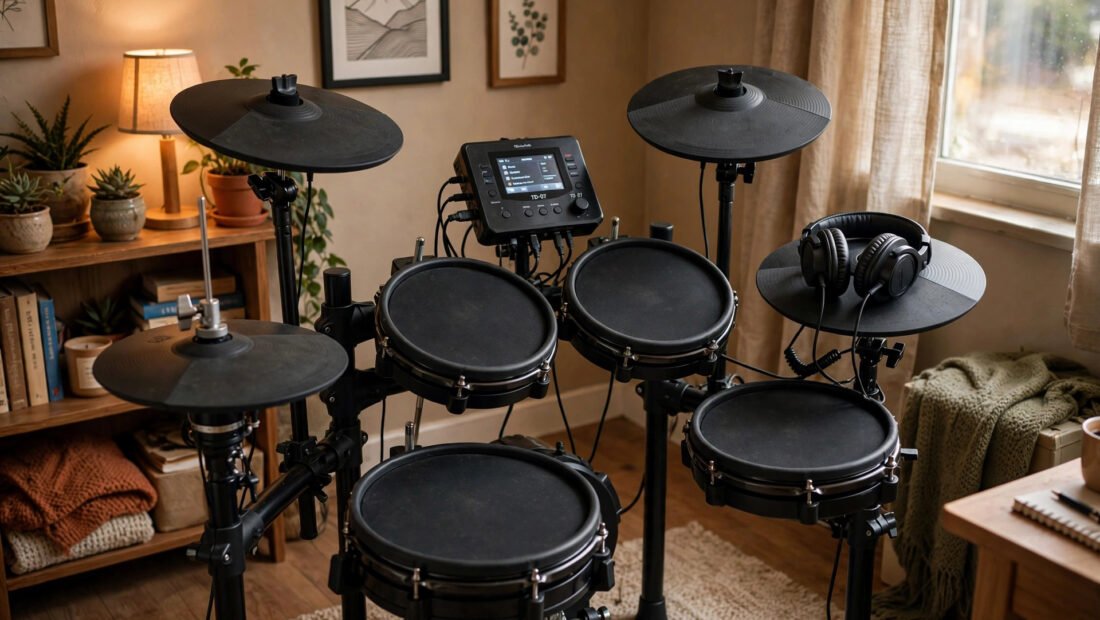
Drums are the instrument everyone wants to learn and no neighbour wants to hear. An acoustic kit hits 100–120 decibels — louder than a chainsaw, audible through walls, floors and double glazing. In terraced houses, flats and semis — i.e., most of Britain — learning on an acoustic kit is a fast track to noise complaints, council involvement and miserable neighbour relations. But giving up is unnecessary: quiet practice is a solved problem.
This guide covers how to learn drums without starting a neighbourhood war: the quiet gear that works, soundproofing that actually helps, your legal position, and whether you need a teacher.
Do You Need a Professional Teacher?
Short answer: not strictly, but it helps enormously at the start. Drums are physical — grip, posture, stroke technique — and bad habits formed alone (death-grip on sticks, hunching, playing through wrist pain) are hard to unlearn and can cause repetitive strain injuries. Four to eight lessons with a good teacher at the beginning buys correct fundamentals; after that, self-directed practice with online resources works well for many.
Finding one: the Musicians’ Union directory, local music schools, and community recommendations. Expect £25–£45 an hour outside London, more within. Many teachers now offer online lessons — ideal if you are practising quietly on an electronic kit with headphones. Alternatively, structured apps and video courses (Drumeo, Stephen Taylor’s lessons) provide curriculum-grade instruction for a subscription. The key is feedback on technique early; timing and feel can be self-taught, but grip faults need eyes on them.
The Quiet Gear: Electronic Kits
Electronic drum kits are the definitive answer to neighbour-friendly drumming. Modern mesh-head kits feel remarkably like acoustic drums, produce negligible acoustic noise (just the thud of sticks on pads — roughly conversation level), and output through headphones. A beginner kit (£250–£450: Alesis, Roland, Donner) is perfectly adequate for the first two years; mid-range kits (£500–£900) add better feel, more kit sounds and durability.
What to check: mesh heads (not rubber pads — rubber is louder and feels worse), a kick pedal that suits your floor (vibration through floors bothers downstairs neighbours more than airborne sound — a tennis-ball riser platform or thick rug underneath solves most of it), and a module with coaching features (built-in metronome, play-along tracks). Which? reviews electronic kits periodically. Buy second-hand with confidence — electronic kits are durable, and used Rolands hold value well.
Even Quieter: Practice Pads and Low-Volume Cymbals
For the absolute minimum noise (flats with thin walls, late-night practice), a practice pad (£15–£30) plus sticks develops rudiments, speed and control silently — every professional drummer still uses one. It is boring but brutally effective: 20 minutes of pad rudiments daily builds technique faster than an hour of unstructured kit bashing.
The middle ground: low-volume cymbals (perforated, ~70% quieter than standard) and mesh-head conversions for acoustic kits let you keep a real kit’s feel at neighbour-tolerable volumes. Combined with hot-rod sticks (bundled dowels, quieter than sticks) or brushes, an acoustic kit becomes flat-viable for practice — though never silent.
Soundproofing: What Actually Works
Honest truth: true soundproofing (stopping drum noise leaving a room) is expensive — mass, decoupling and sealing, typically £2,000+ for a small room, and rarely viable in rentals. What most people actually need is sound reduction, which is far cheaper: seal door gaps (most sound leaks through gaps, not walls), hang heavy curtains or moving blankets on shared walls, put the kit on a rug or riser platform (kills floor vibration — the main downstairs complaint), and choose your room (a ground-floor room away from shared walls beats a bedroom above the neighbour’s living room).
But the highest-impact move is not physical — it is social. Talk to your neighbours before you start: explain you are learning, that you are using an electronic kit with headphones, agree practice hours (e.g. never before 9am or after 8pm), and give them permission to tell you if it is too loud. Neighbours who feel consulted tolerate far more than neighbours who feel ambushed. This single conversation prevents more disputes than any amount of foam.
Your Legal Position (UK)
Know the law, even if you never need it. Local councils can investigate noise complaints under the Environmental Protection Act 1990 — persistent, unreasonable noise can lead to abatement notices and ultimately equipment seizure, though this is the endpoint of a long process, not the first step. Most areas have no fixed “quiet hours” in law, but 11pm–7am is the commonly applied night-time period. Tenancy agreements often include noise clauses with swifter consequences than council action.
The practical reality: councils expect you to have taken reasonable steps (quiet gear, agreed hours), and complainants to have tried resolving it directly first. An electronic kit, reasonable hours and a prior friendly chat put you on very solid ground. Keep a practice log if relations are tense — evidence of reasonableness matters if it ever escalates. And remember the goal that makes it all worthwhile: playing live. When you are ready, finding live music gigs near you cheaply is the natural next step — and if you are wondering about the future of human musicianship, see whether AI will replace real musicians. BBC music news tracks the drumming world too.
The First 30 Days: A Practice Plan
Gear sorted, neighbours warned — now what? The beginner plan that actually works: 20–30 minutes daily, split into three parts. First, 5–10 minutes of rudiments on the practice pad (single strokes, double strokes, paradiddles with a metronome — boring, foundational, transformative). Second, 10 minutes of coordination exercises on the kit (basic rock beat: kick on 1 and 3, snare on 2 and 4, hi-hat eighths — then simple variations). Third, 5–10 minutes playing along to a song you love at reduced speed. This structure builds technique, coordination and joy in every session — and joy is what gets you to day 31. Track progress weekly with a phone recording; the improvement over a month is audible and hugely motivating.
Conclusion
You do not need a professional to start learning drums, but a few early lessons prevent bad habits. Practise on an electronic kit with headphones (or a practice pad for near-silence), tame floor vibration with rugs or risers, agree hours with neighbours before you start, and know your legal position under the Environmental Protection Act. Quiet practice is a solved problem — the only thing standing between you and drumming is starting.
Frequently Asked Questions
Can I learn drums in a flat?
Yes — on an electronic kit with headphones, or a practice pad for rudiments. Acoustic kits in flats are asking for complaints; electronic kits are conversation-level quiet (mind floor vibration for downstairs neighbours).
How much does it cost to start learning drums?
£250–£450 for a beginner electronic kit, £15–£30 for a practice pad and sticks, plus £25–£45 per lesson if you take a few to start. Second-hand kits stretch the budget further.
Do I need lessons or can I learn drums online?
A few early lessons are strongly recommended for grip and posture (bad habits cause injuries), after which online courses and apps work well. Pure self-teaching risks technique faults that are hard to unlearn.
What are the noise rules for drums in the UK?
Councils can act on persistent unreasonable noise under the Environmental Protection Act 1990. There is no universal decibel limit for homes, but 11pm–7am is the commonly applied night period, and tenancy agreements often add their own rules.