
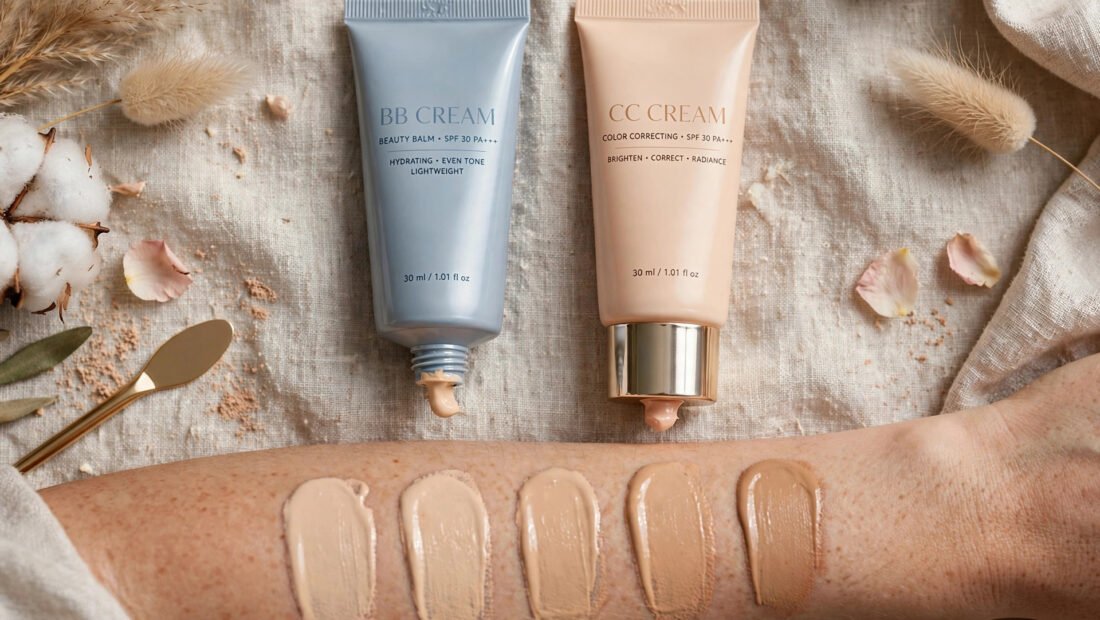
Walk into any Boots and you will find BB creams, CC creams, and now DD and EE creams jostling for shelf space, each promising to be your moisturiser, primer, foundation, sunscreen and skincare serum in one tube. The alphabet soup is marketing as much as science — but underneath it, BB and CC creams genuinely differ, and one of them probably suits your skin better than the other.
This guide cuts through the hype: what BB and CC creams actually are, how they differ, which skin types each suits, and whether you should care at all.
What BB Cream Actually Is
BB (beauty balm, or blemish balm) originated in Germany as post-procedure coverage, was perfected in South Korea, and conquered the West in the 2010s. The concept: a tinted moisturiser with benefits — light coverage plus skincare ingredients (hyaluronic acid, niacinamide, antioxidants) plus SPF. Coverage is sheer to light, the finish is dewy, and the feel is like a rich moisturiser with a hint of tint.
BB cream’s strengths: it evens out mild redness and uneven tone while looking like skin, it is fast (one product instead of three), and it suits dry, normal and mature skin that wants glow rather than mattifying. Its weaknesses: shade ranges are often limited, coverage will not conceal significant blemishes or dark circles, and the SPF — while real — is rarely applied in sufficient quantity to deliver the labelled protection (you would need a full finger-length of product).
What CC Cream Actually Is
CC (colour correcting) cream came next, positioned as the more sophisticated sibling. The key difference: colour-correcting pigments. CC creams contain encapsulated pigments (often green, peach or lavender tones) that counteract specific discolouration — green neutralises redness, peach brightens sallow or dark tones, lavender counteracts yellow. Coverage is typically light to medium — a step up from BB — with a more matte or natural finish.
CC cream’s strengths: better at visibly correcting redness, sallowness and uneven tone; often suits oily and combination skin better (many formulas are lighter and less dewy); and the higher coverage means some people can skip concealer. Weaknesses: the colour-correcting effect varies wildly between formulas (some do almost nothing), shade ranges can be equally limited, and the texture can feel heavier than BB.
BB vs CC: The Honest Comparison
Coverage
BB: sheer to light. CC: light to medium. If you want “no-makeup makeup,” BB. If you want visible evening of tone, CC.
Finish
BB trends dewy and luminous; CC trends natural to matte. Dry skin usually prefers BB’s glow; oily skin usually prefers CC’s control.
Skincare benefits
Both claim them; both deliver modestly. Neither replaces a dedicated serum — the active concentrations are low and contact is brief. Treat skincare claims as a bonus, not the reason to buy.
SPF
Both typically include SPF 15–30, and both are unreliable as your sole sun protection because nobody applies enough. The NHS sunscreen guidance is clear about proper application quantities — consider your BB/CC’s SPF a top-up over dedicated sunscreen, not a substitute.
Shade range
Historically poor for both, improving slowly. Western BB/CC creams still skew light; K-beauty options often offer only 2–3 shades. If you are deeper than medium-tan, swatch carefully or look to tinted moisturisers with proper ranges instead.
Which Should You Choose?
Dry, normal or mature skin wanting glow and simplicity: BB cream. Oily, combination or redness-prone skin wanting correction and control: CC cream. Significant blemishes, dark circles or scarring to cover: probably neither — you want a proper foundation or a BB/CC plus concealer. Minimal routine devotees: BB for speed. “I want to look polished with one product” pragmatists: CC for the extra coverage.
And the secret third option: tinted moisturiser or skin tints, which have quietly improved to the point of outclassing both — better shade ranges, modern textures, honest marketing. Which? blind-tests these categories regularly and often finds high-street options beating premium ones. The British Skin Foundation is a good reality check on the skincare claims all these products make.
How to Apply Them Properly
BB and CC creams reward good application and punish bad. Start with moisturised skin (they are not moisturisers, whatever the tube claims — on dry skin they cling and patch). Use a pea-sized amount for the whole face; these are concentrated, and over-application is why they look mask-like. Fingers work well — the warmth helps them melt in — or a damp sponge for a sheerer finish. Press and blend outward from the centre of the face, and take the extra ten seconds to blend the jawline and around the nose where product accumulates.
Layer strategically: sunscreen first (let it set for a few minutes), then BB/CC, then concealer only where needed, then a whisper of powder on oily zones if you are combination. Setting spray extends wear meaningfully — these formulas are not known for longevity. And remove them properly at night: most contain silicones and SPF, so a proper cleanse (not just micellar water wiped once) prevents the congestion that gives tinted products a bad name.
What about DD and EE creams?
Marketing extensions, mostly. DD (“daily defence” or “dermatologically defining”) creams emphasise anti-ageing; EE (“extra exfoliating”) creams add exfoliating acids. Neither category is standardised — the letters mean whatever the brand wants. Judge them as individual products (ingredients, coverage, shade) and ignore the alphabet entirely. The industry will be on ZZ cream by 2030; your skin will not know the difference.
Do You Actually Need Either?
Here is the contrarian truth: BB and CC creams solve a problem many people do not have. If you already moisturise, wear sunscreen and occasionally want light coverage, a good tinted moisturiser does the same job. If you want real coverage, foundation does it better. BB/CC creams occupy a middle ground that is perfect for exactly one person: someone who wants a single fast morning product with light coverage and does not need serious correction or serious sun protection from it.
That person exists — busy parents, minimalists, the “five-minute face” crowd — and for them, the right BB or CC cream is genuinely the ideal product. For everyone else, it is an optional extra, not an essential. Do not let alphabet marketing convince you that your routine is incomplete without one. Pair whichever you choose with colours that flatter — see what colours suit pale skin tones — and keep the rest of your routine honest, including hair health in your 30s, which no cream can fix.
Conclusion
BB creams offer sheer, dewy, moisturiser-like coverage — best for dry to normal skin wanting glow and speed. CC creams offer light-to-medium colour-correcting coverage — best for oily, combination or redness-prone skin wanting more polish. Neither replaces sunscreen properly, shade ranges remain imperfect, and many people are better served by a modern skin tint. Choose based on your skin type and coverage needs, not the alphabet — and skip both entirely if they do not solve a problem you actually have.
Frequently Asked Questions
What is the difference between BB and CC cream?
BB (beauty balm) is a tinted moisturiser with sheer, dewy coverage. CC (colour correcting) adds colour-correcting pigments for redness and uneven tone, with light-to-medium coverage and a more natural finish.
Can BB or CC cream replace foundation?
For light coverage needs, yes. For moderate to full coverage — blemishes, significant redness, dark circles — no; you will need foundation or concealer alongside.
Do BB creams have enough SPF?
The SPF is real but unreliable as sole protection, because effective sun protection requires far more product than anyone applies for coverage. Use dedicated sunscreen underneath.
Which is better for oily skin?
Usually CC cream — the formulas tend to be lighter, less dewy and more mattifying than BB creams, with better oil control through the day.


