
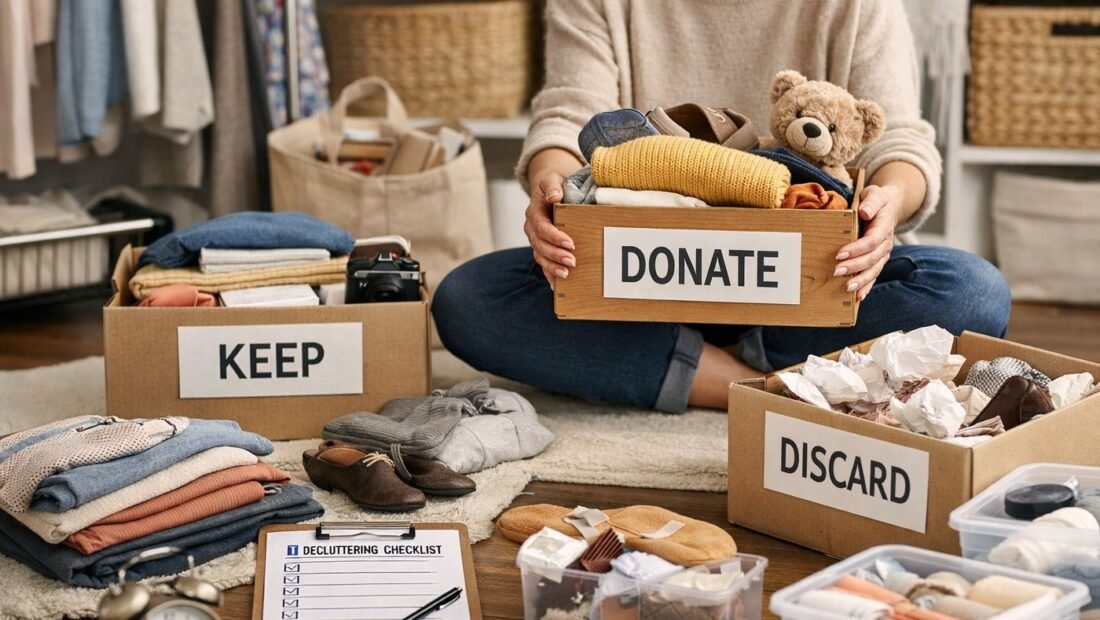
The word “declutter” makes most of us picture bin bags and regret — chucking out things we later miss. But if you’re asking how do I declutter my home without throwing everything away, you’re asking the right question. Real decluttering isn’t about disposal; it’s about deciding what deserves space in your home.
I’m not a minimalist and I don’t want to be. I like my books, my weird souvenirs, my grandmother’s plates. Here’s how to get the calm of a tidy home without the trauma of the bin bag.
Reframe: You’re Curating, Not Discarding
The biggest mindset shift: decluttering means choosing what stays, not mourning what goes. Everything in your home should either be useful, beautiful, or meaningful — ideally more than one. If an object is none of those, it’s not “wasteful” to move it on; it’s respectful of the things that matter.
How to Declutter Without Throwing Everything Away
1. Start with the easy wins: actual rubbish
Every home has genuine rubbish masquerading as clutter: dead batteries, dried-up pens, expired medicines, takeaway menus from closed restaurants, cables for devices you no longer own. A “rubbish hunt” through one room takes 15 minutes and creates visible progress with zero emotional pain. Check gov.uk for how to recycle batteries and electronics in your area.
2. Use the “maybe box”
For things you’re not ready to decide on, use a maybe box: seal it, date it, put it in the loft or under the bed. If you haven’t opened it in six months, you have your answer — and you never had to make a painful decision in the moment. This single trick removes 90% of decluttering guilt.
3. Rehome, don’t bin
So much “clutter” is just stuff in the wrong place. The books you loved but won’t reread? A Little Free Library or charity shop. The kitchen gadget you never use? Someone on Freecycle or Olio wants it today. Clothes? Charity shops, textile recycling, or sell on Vinted. Knowing things go to a good home makes letting go dramatically easier.
4. Digitise the paper mountain
Paper is the stealth clutter of British homes: bank statements, manuals, kids’ artwork, old cards. Scan or photograph what matters (there are free scanning apps that do a decent job), keep the truly essential originals in one file, and recycle the rest. Manuals for appliances? They’re all online — recycle with confidence. For photos specifically, see our guide to organising family photos digitally.
5. One category at a time, not one room
Rooms contain mixed categories, which is why room-by-room decluttering stalls. Instead, do all the books, then all the clothes, then all the kitchen gadgets. Gathering every item in a category together is eye-opening — you might own seven wooden spoons without realising — and decisions get easier with each one.
6. Apply the “would I buy this today?” test
For duplicates and maybes, ask: if I saw this in a shop today, at full price, would I buy it? If the answer’s no, it’s not earning its shelf space. This works brilliantly for gifts you never liked and sale purchases that were never quite right.
7. Create a proper home for everything you keep
Clutter is often just homeless stuff. The scissors live in the kitchen drawer, the tape lives in the desk, the phone charger lives by the bed — and everything goes back after use. This is especially transformative in small spaces; our guide to organising a small UK kitchen is built on exactly this principle.
8. Deal with sentimental items last — and keep the best
Sentimental clutter is the hardest, so leave it till you’ve built your decision muscles on easier categories. And you don’t have to keep everything: keep the one letter that makes you cry, photograph the rest. Keep your grandmother’s favourite plate, not the whole chipped set. Curate the memories instead of warehousing them.
9. Stop the inflow
Decluttering while still acquiring is like bailing a boat with a hole in it. Unsubscribe from marketing emails, institute a 48-hour rule for non-essential purchases, and see our guide to stopping impulse buying online. The tidiest homes aren’t the ones decluttered most — they’re the ones filled most carefully.
What If You Live With Other People?
Declutter only your own stuff. Seriously. Touching someone else’s belongings without permission breeds resentment, not tidiness. Declutter your things visibly and well; partners, kids and housemates often follow suit when they see how good it feels — and if they don’t, that’s their call.
The Clutter Hotspots (And How to Fix Each One)
The hallway: shoes multiply by the door. One pair per person by the door, the rest in bedrooms — a small shoe rack enforces it. The kitchen worktop: appliances you use weekly earn worktop space; everything else lives in cupboards. The bedroom chair: the infamous “chairdrobe.” Fix it with a proper laundry system: a basket for dirty, hooks for worn-once. The bathroom: decant or corral — a single tray for daily products stops the creep across every surface. The desk: clear it completely once, then only return what you used in the last week.
Each hotspot takes about 20 minutes. Do one per evening for a week and the whole house feels different — without a single bin bag of regret.
Maintaining It: The Habits That Keep Clutter Away
- The 5-minute reset — every evening, return strays to their homes. Five minutes prevents the slow creep.
- One in, one out — new book? An old one goes to the charity shop. New shirt? One leaves the wardrobe.
- The Sunday sweep — ten minutes weekly: one drawer, one shelf, one surface. Rotating maintenance beats annual purges.
- A “donate” bag by the door — when you notice something you don’t need, it goes straight in the bag. When the bag’s full, it goes to the charity shop. No decisions, no piles.
Decluttering is 20% sorting and 80% habits. The sort is satisfying; the habits are what keep your home calm for years.
The Practical Takeaway
Decluttering without throwing everything away means: bin the actual rubbish, maybe-box the maybes, rehome the rest, digitise the paper, and stop the inflow. You get to keep everything you love — that’s rather the point. A decluttered home isn’t an empty one; it’s one where everything in it earned its place.




1 Comment