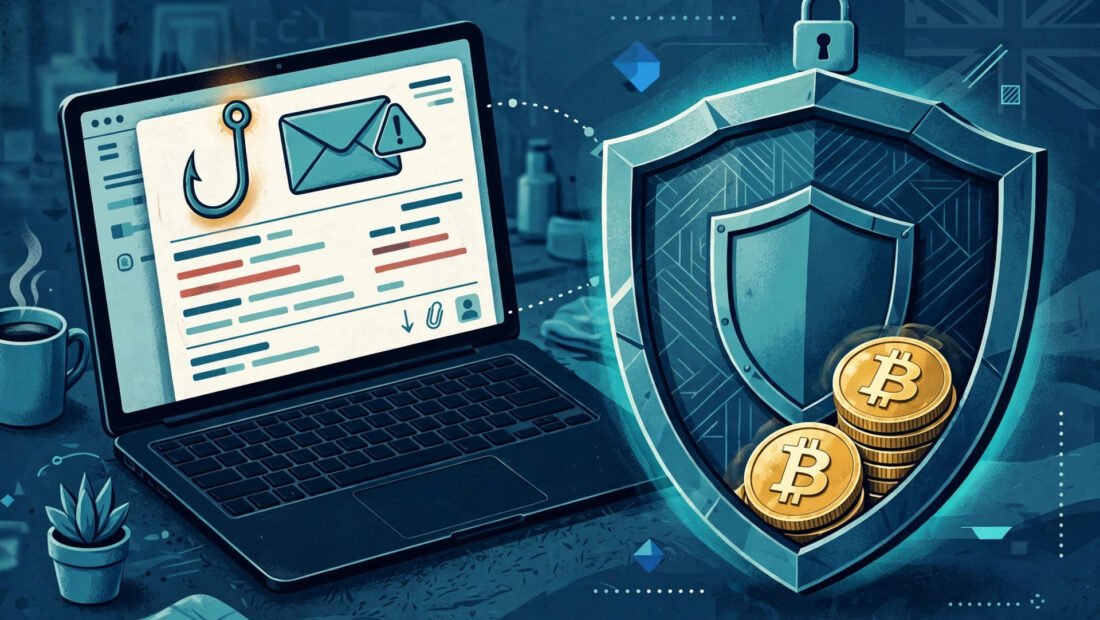
Imagine this: it is a quiet Tuesday evening in a terraced house in Leeds, and an email lands in your inbox claiming your crypto exchange account has been locked. Your stomach drops. You click the link, enter your login, and in the space of three minutes your savings in Bitcoin and Ethereum have vanished into a wallet you will never trace. This is not a rare horror story — phishing is the single most common way everyday British households lose their crypto. So how often should you actually be thinking about phishing protection? The honest answer: not once a year, not once a month — but constantly, as a living habit woven into your digital life. This guide explains exactly what that means in practice, how phishing scams aimed at UK crypto holders really work, and the concrete routine that will keep your household safe.
Why Crypto Phishing Is Different — and More Dangerous
Most of us have learned to delete the odd suspicious email from a “bank”. Crypto phishing is nastier for three reasons. First, crypto transfers are irreversible: unlike a card payment, once your coins leave your wallet there is no fraud department to reverse it and no chargeback. Second, thieves only need one moment of weakness — a single login captured on a fake exchange page can empty your account in minutes. Third, attackers actively target UK holders using British-looking brands: fake emails dressed up as messages from HMRC about “crypto tax owed”, bogus FCA warnings, and clones of popular UK-facing exchanges.
Phishing does not need to be constant to be devastating — it only needs to succeed once, which is why it remains among the most reported cybercrimes in the UK.
The Real Answer: Protection Is Continuous, Checks Are Weekly
Thinking of phishing protection as a single task you “do” is the trap. A better model used by security professionals is continuous awareness plus scheduled reviews. Here is what that looks like for a household:
1. Daily: the three-second rule
Every single day, when an email mentions crypto, money or account security, pause for three seconds before clicking anything. Read the sender address character by character. Real exchanges never ask you to log in via an email link to “verify” your wallet. If the email creates urgency — “your account will be closed in 24 hours” — that urgency is the weapon. In 2026, with AI-generated phishing emails now grammatically flawless, the old advice of “look for spelling mistakes” no longer works. The pause is the protection.
2. Weekly: a five-minute inbox audit
Once a week, spend five minutes checking your spam and junk folders for anything that slipped through, and reviewing any crypto-related emails you received. Report phishing attempts to your exchange and forward them to the National Cyber Security Centre’s Suspicious Email Reporting Service at the NCSC’s guidance on reporting suspicious emails. This weekly habit builds pattern recognition: you start to recognise the same tricks — fake “deposit received” notifications, fake airdrops, fake support staff.
3. Monthly: security settings review
Once a month, log into your exchange accounts directly (type the address yourself — never via a link) and check your login history, connected devices and authorised API keys. Revoke anything you do not recognise.
How Phishing Scams Aimed at UK Households Actually Work
Understanding the playbook makes the attacks obvious. The most common variants include:
Fake exchange login pages. You receive an email about a “suspicious login attempt” with a link to a pixel-perfect copy of your exchange. The moment you type your credentials, the attacker uses them on the real site. Some versions even capture your two-factor code in real time.
HMRC and tax-threat emails. Attackers impersonate HMRC, claiming you owe tax on crypto gains and must pay immediately via a link. HMRC’s official guidance on tax and cryptoassets confirms HMRC will never demand payment by email link or ask for wallet details. Knowing the official process defuses the panic these emails rely on.
Social media support impersonation. You post a question about your exchange, and within minutes “support staff” direct-message you with a helpful link. Real exchanges never provide support through direct messages. The Financial Conduct Authority’s consumer page on cryptoassets warns specifically about impersonation scams.
Fake airdrops and giveaways. “Send 0.1 ETH to receive 1 ETH back.” Every giveaway requiring you to send crypto first is a scam, no exceptions. Celebrity endorsement videos are now routinely faked with AI.
Household-Level Protection: Make It a Family System
In many UK homes, more than one person interacts with the family’s crypto — a partner checks prices, a teenager holds a small amount, a parent manages the main account. Phishing protection has to be household-wide because attackers will probe the weakest member. Sit down once and agree on simple rules:
- Never click links in crypto-related emails or texts — navigate to sites manually.
- Never share seed phrases or passwords with anyone, including supposed “support staff”.
- Use a dedicated email address for crypto accounts that is never published anywhere else.
- Keep a shared note of the official website addresses of every exchange and wallet you use, so nobody has to guess or search (scammers buy ad placements on search engines).
- Agree that any urgent-sounding money message gets a five-minute cool-down and a second opinion.
Families with children should also talk openly about what happens when personal details are shared with online chat tools and strangers, because the same social-engineering tricks used by phishing emails also appear in chats and messages aimed at young people.
Tools That Genuinely Help — and Their Limits
Technology can reduce your exposure dramatically. A password manager generates and stores unique passwords so a phishing site that steals one login gains nothing elsewhere. An authenticator app or, better, a hardware security key makes stolen credentials far less useful — note that SIM-swap attacks mean SMS-based two-factor codes are the weakest option, so upgrade away from them when you can. Most email providers now offer phishing protection filters; keep them on.
But tools do not replace judgement: phishing pages now carry valid HTTPS certificates, so the padlock icon means nothing. The habit of pausing, verifying and typing addresses manually is the one defence that survives every evolution of the scam.
What to Do If You Have Already Clicked
It happens, even to careful people. Speed matters. First, move any remaining funds to a new wallet whose seed phrase has never touched the compromised device. Second, change your email password and revoke all sessions and API keys on every exchange. Third, report the incident to Action Fraud, the UK’s national fraud and cybercrime reporting centre, and to your exchange — while recovery is unlikely, reporting builds the intelligence that shuts these networks down. Fourth, if bank details were involved, call your bank immediately.
Conclusion
So, how often should a UK household protect its crypto from phishing emails? Every day in awareness, weekly in review, and monthly in settings — because phishing is not a storm that passes but a permanent climate. The good news is that the routine is simple: pause before you click, navigate manually, keep two-factor authentication strong, and treat every urgent money message with suspicion. Build those habits once and they become second nature — and a household with good habits is the hardest target a scammer will ever face.
Frequently Asked Questions
Can phishing emails steal crypto directly, or just passwords?
They cannot reach into your wallet directly, but stolen exchange logins, seed phrases captured on fake wallet sites, and malicious “sign this transaction” prompts in fake apps all lead to the same result: your crypto moved to the attacker’s wallet, usually within minutes.
Does using public Wi-Fi make phishing worse?
Yes — public networks make it easier for attackers to intercept traffic and redirect you to fake sites. If you ever need to check a crypto account away from home, using a trusted mobile connection and being extra cautious about the exact website address is far safer. The risks of using public Wi-Fi in cafés and airports apply just as much to crypto accounts as to banking.
Are crypto phishing emails illegal to report to my exchange?
No — reporting them is exactly what exchanges and the authorities want. Forward suspicious emails to the NCSC’s reporting service and report scams to Action Fraud. You are helping protect other households too.
Should I use a separate email address for crypto accounts?
Absolutely. A dedicated, unpublished email address for your exchange and wallet accounts dramatically reduces the phishing emails you receive in the first place, because attackers cannot find the address to target.
Is SMS two-factor authentication enough?
It is far better than nothing, but SMS codes can be intercepted through SIM-swap fraud. Authenticator apps and hardware security keys are significantly stronger, and worth setting up for any account holding meaningful value.