
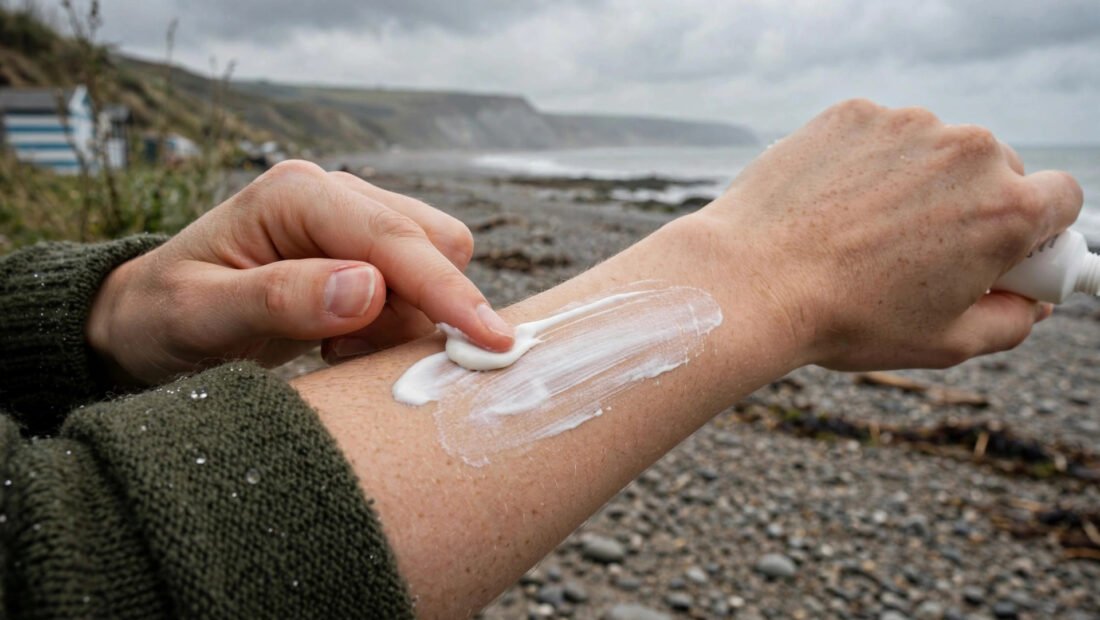
“But it’s cloudy.” The most British objection to sunscreen — and the most misguided. Up to 80% of UV radiation penetrates cloud cover, UVA (the ageing, cancer-contributing kind) passes through window glass, and cumulative daily exposure is what ages skin and drives skin cancer risk. Britain’s 1,700+ annual melanoma deaths are not all from beach holidays; they are from decades of unprotected incidental exposure.
This guide explains SPF from scratch: what the numbers actually mean, UVA versus UVB, how much to apply (you are using too little), and how to build a daily sunscreen habit that survives British weather and British scepticism.
What SPF Numbers Actually Mean
SPF (Sun Protection Factor) measures protection against UVB — the burning rays. SPF 30 blocks about 97% of UVB, SPF 50 about 98%. The difference between 30 and 50 is small in percentage terms but meaningful in real-world use, because nobody applies the laboratory quantity (see below) — higher SPF compensates for under-application.
The critical misunderstanding: SPF is not linear time. SPF 30 does not mean 30 times longer in the sun; it means 1/30th of UVB reaches your skin at the tested application thickness. And SPF says nothing about UVA — the rays that cause premature ageing and contribute to skin cancer — which is why you must look for the UVA star rating or circle logo too.
UVA vs UVB: Why You Need Both
UVB causes burning and plays the major role in most skin cancers; it varies hugely by season, time of day and cloud (weak in a British January, strong at noon in July). UVA penetrates deeper, drives premature ageing (wrinkles, pigmentation, loss of elasticity), contributes to skin cancer, and is present at near-constant levels year-round — through clouds and through glass. Your office window protects you from UVB, not UVA.
In the UK, look for the UVA star rating (1–5 stars, awarded relative to the SPF) or the EU UVA-in-a-circle logo (meaning UVA protection is at least one-third of the SPF). A sunscreen labelled SPF 50 with 5 stars or the circle logo is broad-spectrum; SPF 50 with no UVA mark is half a sunscreen. The NHS sunscreen guidance explains the labelling clearly.
How Much to Apply (You Are Using Too Little)
The two-finger rule: a line of sunscreen along the index and middle fingers is roughly the right amount for face and neck. For the body, it is about 35ml — a full shot glass — for full coverage. Studies consistently find people apply 25–50% of the tested amount, which means your SPF 50 is performing like SPF 15–20.
Reapplication matters as much as quantity: every two hours outdoors, and immediately after swimming, heavy sweating or towelling. “Once-a-day” formulas exist and are better than nothing, but reapplication remains the gold standard for extended exposure. Daily incidental exposure (commute, school run, lunch break) is well served by a proper morning application; a full day outdoors needs the two-hour discipline.
Choosing a Sunscreen You Will Actually Wear
The best sunscreen is the one you use daily, so texture and finish matter more than marginal SPF differences. Chemical (organic) filters tend to feel lighter and leave less white cast; mineral (inorganic) filters (zinc oxide, titanium dioxide) suit sensitive skin but can cast on deeper tones — tinted mineral formulas solve this. Combination filters split the difference.
For daily wear under makeup, look for fluid or gel textures labelled for face use; they layer better than thick beach creams. Oily skin suits mattifying or “dry touch” formulas; dry skin suits hydrating ones. Do not rely on SPF in moisturiser or foundation as your sole protection — the application quantity problem again. Dedicated sunscreen first, makeup over it. Cancer Research UK and the British Association of Dermatologists both publish guidance on choosing protection.
Sunscreen for Children: The Non-Negotiables
Children’s skin is more vulnerable to UV damage, and childhood sunburn significantly raises lifetime melanoma risk — this is where sunscreen discipline matters most. Use SPF 50 with high UVA protection, apply 15–30 minutes before going out, reapply every two hours and after swimming, and do not rely on “once-a-day” claims for a full day at the beach. Hats, shade and cover-ups matter as much as lotion; sunscreen is the last line of defence, not the first.
Make it a non-negotiable routine like tooth-brushing rather than a negotiation — children accept what is consistent. Keep a bottle by the front door and in the school bag during summer term. And model the behaviour: children who see parents applying sunscreen daily grow into adults who do the same. The NHS guidance includes specific advice for babies and children, including keeping babies under six months out of direct sun entirely.
Common Sunscreen Mistakes (Beyond Under-Application)
Using last year’s bottle: most sunscreens last 12 months after opening (check the PAO symbol); expired filters degrade and underperform. Missing the ears, neck, lips and feet: the classic patchy burn pattern. Applying over makeup instead of under it: sunscreen goes on clean skin, makeup over the top — reversing the order destroys protection. Using body sunscreen on the face: it works, but the texture pills under makeup and discourages daily use; face-specific formulas exist for a reason. And the biggest psychological mistake: treating sunscreen as holiday-only. The daily incidental exposure across a British year exceeds most people’s annual holiday dose — the habit matters more than the holiday bottle.
Building the Daily Habit in Britain
The habit fails on psychology, not information. Tactics that work: keep the sunscreen next to your toothbrush or moisturiser (habit stacking), choose one you enjoy wearing (no white cast, no grease, no pilling under makeup — test until you find it), and reframe it as anti-ageing rather than sun protection — vanity motivates where health warnings do not. Apply to the forgotten zones: ears, neck, backs of hands (hands show age fastest and are almost never protected), and the parting or hairline.
Seasonal honesty: yes, apply year-round. UVA is constant, winter sun at altitude (skiing) is intense, and snow reflects up to 80% of UV. The “only on sunny days” approach misses most of your cumulative exposure. And remember sunscreen is one layer of defence, not a force field — shade, hats and sunglasses matter too, especially for children.
Skin protection is part of a bigger picture of looking after yourself: the right shades flatter protected skin beautifully (see what colours suit pale skin tones), and overall health shows in skin and hair together (hair thinning in your 30s shares many of the same lifestyle drivers).
Conclusion
SPF measures UVB protection; you also need UVA protection (stars or circle logo); apply far more than you think (two fingers for face, shot glass for body); reapply every two hours outdoors; choose a texture you will wear daily; and apply year-round — clouds and glass do not stop UVA. Daily sunscreen is the single most effective anti-ageing and skin-cancer-prevention step available, and it costs pennies a day.
Frequently Asked Questions
Do I need sunscreen in the UK in winter?
Yes — UVA, which causes ageing and contributes to skin cancer, is present year-round and penetrates cloud and glass. Daily facial SPF is recommended regardless of season.
Is SPF 50 much better than SPF 30?
Marginally in lab terms (98% vs 97% UVB blocked), but meaningfully in real life, because under-application is universal and higher SPF compensates. Either is fine if applied properly and generously.
Can I rely on SPF in my moisturiser?
Not as sole protection — nobody applies enough moisturiser to reach the labelled SPF, and most lack adequate UVA ratings. Use dedicated sunscreen underneath.
Does sunscreen prevent vitamin D deficiency?
Real-world studies show sunscreen users are not more vitamin-D deficient — under-application and incidental exposure provide plenty. In the UK, autumn and winter supplementation is recommended regardless.


