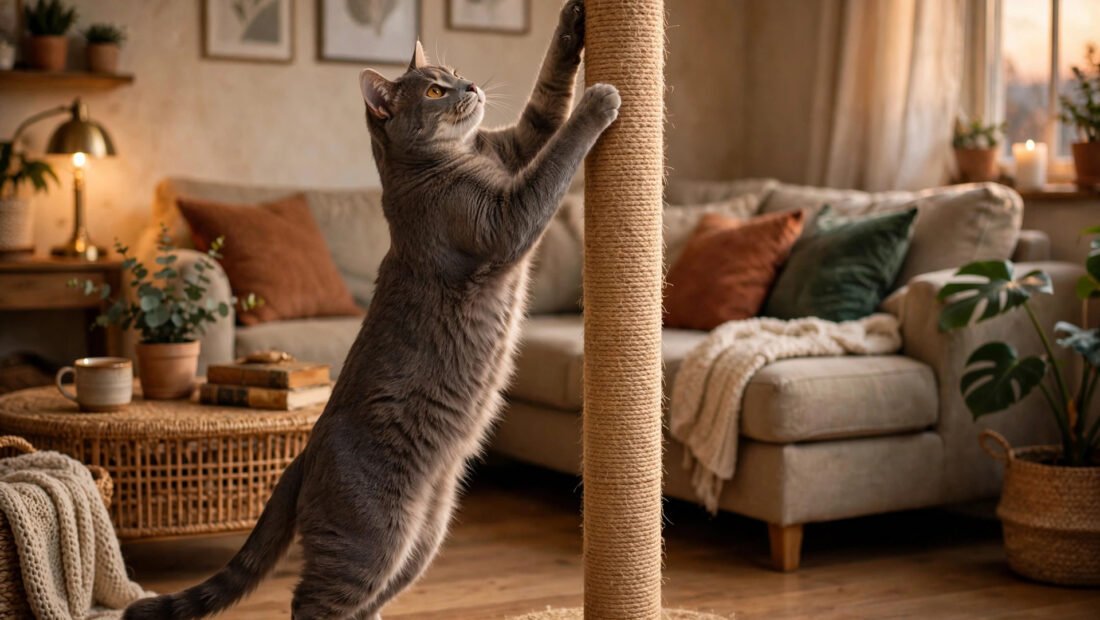
Your cat is not destroying your sofa out of spite. Scratching is as natural to cats as purring — it maintains their claws, stretches their bodies, and marks territory with scent glands in their paws. Punishing a cat for scratching is like punishing a dog for barking: it fights biology and always loses. The beginner’s goal is not to stop scratching, but to redirect it somewhere you approve of.
This guide covers the safest, most effective ways to protect your furniture — the right scratching posts, placement tricks most owners miss, deterrents that actually work, and the mistakes that make scratching worse.
Understand What Scratching Does for Your Cat
Cats scratch for three reasons. Physically, it removes the dead outer sheath of the claw and stretches the muscles of the back and shoulders — watch a cat scratch and you will see the full-body stretch. Territorially, paw glands deposit scent, marking the spot as theirs. And emotionally, scratching is a stress reliever; cats often scratch after exciting or anxious moments.
This matters because it tells you what the replacement must offer. A scratching post is not just an alternative surface — it must allow a full stretch (tall enough), feel satisfying under the claws (right texture), and sit in a location the cat considers socially significant. Get any of these wrong and the cat will politely ignore your £40 post and return to the sofa arm. Cats Protection’s scratching advice explains these needs from the cat’s perspective.
The Scratching Post: Most Owners Buy the Wrong One
The classic beginner mistake is the short, carpet-covered post tucked in a corner. Cats prefer sisal rope or corrugated cardboard — textures that shred satisfyingly — over carpet, which feels too similar to the sofa you are trying to protect. Height is critical: the post must be tall enough for your cat to stretch fully upright, which means at least 75–80cm for an average cat, sturdy enough not to wobble (a wobbling post teaches the cat that posts are untrustworthy), with a wide, heavy base.
Offer variety: a tall vertical post plus a horizontal cardboard scratcher covers most preferences. Some cats strongly prefer horizontal scratching — if yours ignores vertical posts, try a flat cardboard lounger before concluding they “won’t use one.” Place posts where the cat already scratches, not where they look tidy. You can move them gradually once the habit transfers.
Placement: The Secret Nobody Tells Beginners
Cats scratch where it is socially meaningful: near sleeping spots (the classic post-nap stretch-and-scratch), near entrances, and on prominent furniture. A scratching post hidden in the spare bedroom will never compete with the sofa arm in the living room. Put the post right next to the targeted furniture — even if it looks cluttered for a few weeks.
Make the post attractive and the furniture unattractive simultaneously. Rub catnip into the post, play with a wand toy around it so the cat “discovers” it during fun, and reward with treats the first few times they use it. On the furniture, use double-sided sticky tape (sold specifically as anti-scratch tape) or a draped throw — cats dislike sticky textures and will redirect to the easier option. This two-sided approach works far faster than either tactic alone.
Deterrents That Work (and Ones That Do Not)
Effective: double-sided tape on targeted spots, throws or covers as temporary barriers, Feliway pheromone diffusers near scratching zones (which reduce stress-related scratching), and keeping claws trimmed — blunt claws do less damage, and trimming every 2–3 weeks is a basic skill every owner should learn from their vet.
Ineffective or harmful: shouting or spraying water (the cat learns to scratch when you are not watching, and it damages trust), and declawing — which is illegal in the UK under the Animal Welfare Act 2006 except for genuine medical reasons, because it involves amputating the last bone of each toe. Any vet or “behaviourist” suggesting it should be avoided entirely. The RSPCA’s cat behaviour guidance is clear that scratching problems are solved with environment, not punishment.
Protecting Furniture While You Retrain
Retraining takes 2–4 weeks, and your furniture needs protection in the meantime. Anti-scratch tape is the single best product — transparent, removable, and genuinely disliked by paws. For leather sofas, a fitted throw during the transition period saves the upholstery. Trim claws regularly, and consider soft nail caps (glued vinyl covers) as a temporary measure for persistent offenders — they fall off naturally as claws grow and are far kinder than any aversive method.
Longer term, the most effective furniture protection is a cat with its needs met: enough scratching outlets, daily play sessions (a tired cat scratches less destructively), and vertical territory like shelves or a cat tree. Cats that scratch furniture excessively are often under-stimulated — the sofa is simply the most interesting thing in a boring room. If pet-related mess is a wider concern, our guide to the best budget robot vacuums for homes with pets tackles the fur side of the equation, and whether cat pet insurance is worth it covers the financial side of ownership.
Making the Post Irresistible: The Details That Matter
If your cat sniffs the new post and walks away, the details are usually at fault. Stability is the most underrated factor: the post must not wobble even slightly when the cat pulls on it, because one wobble teaches the cat that posts are unreliable and sofas are not. Wedge it against a wall or choose one with a genuinely heavy base. Texture matters too — tightly wound sisal rope is the gold standard, but some cats prefer the shreddability of corrugated cardboard or even natural wood logs. Observe what your cat scratches now: vertical sofa arms suggest a vertical post; the carpet suggests a horizontal scratcher.
Scent-marking the post helps enormously. Cats have scent glands in their cheeks as well as their paws — gently stroking your cat’s cheek with a cloth and then rubbing the cloth on the post transfers familiar scent and signals “this is yours.” Catnip works for about half of cats (sensitivity is genetic); for the rest, silvervine is a worthwhile alternative. And consider height seriously: cats stretch to their full length when scratching, so a post shorter than your cat’s outstretched body will always lose to the sofa arm. When in doubt, go taller.
Conclusion: Redirect, Don’t Fight, Nature
The safest way to stop a cat scratching furniture is to stop thinking of it as misbehaviour. Give them a tall, sturdy, well-placed sisal post; make the sofa temporarily unappealing; reward every use of the post; trim claws regularly; and enrich their environment so the furniture is not the most exciting thing in the room. Work with the instinct instead of against it, and most cats transfer their scratching within weeks — leaving your sofa, and your relationship with your cat, intact.
Frequently Asked Questions
How do I stop my cat scratching the sofa?
Place a tall, sturdy sisal scratching post directly next to the scratched spot, make the sofa unattractive with double-sided anti-scratch tape, and reward the cat for using the post. Most cats redirect within 2–4 weeks.
Is it cruel to stop a cat scratching?
Stopping all scratching would be cruel — it is a natural, necessary behaviour. The humane approach is redirection: provide appropriate outlets (posts, cardboard scratchers) rather than trying to eliminate the behaviour.
Does declawing stop scratching?
Declawing is effectively banned in the UK under the Animal Welfare Act 2006 (only permitted for medical necessity) because it amputates the last bone of each toe. It causes chronic pain and behaviour problems. Never consider it.
Why does my cat scratch right after I tell them off?
Cats do not connect punishment with the crime — they connect it with you. Scolding teaches the cat to scratch when you are out of sight and damages trust. Redirect and reward instead.