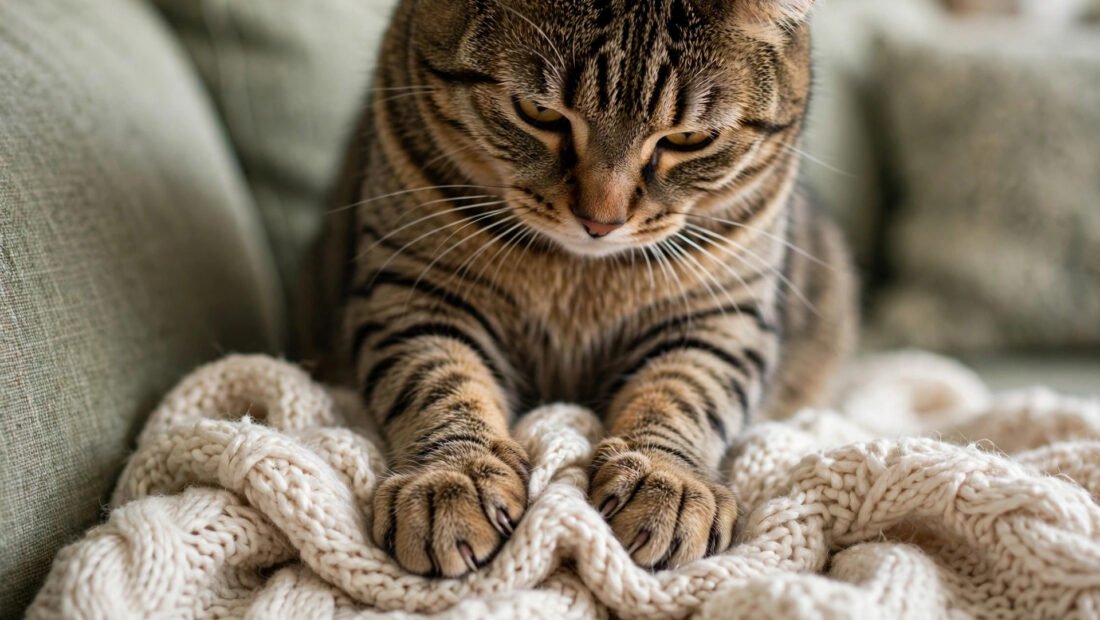
Your cat climbs onto your lap, starts rhythmically pushing its paws in and out against your leg — sometimes with claws — purring like a tiny engine. It is called kneading (or “making biscuits”), and almost every cat does it. But why? The answer is a lovely mix of kittenhood instinct, communication and comfort — with a few nuances most owners never hear about.
This guide explains the real science behind kneading, what your cat is telling you, and the rare occasions when kneading signals something worth checking.
Reason 1: It Starts With Mum
Kneading begins in the first days of life. Newborn kittens knead their mother’s belly to stimulate milk flow while nursing — the rhythmic pressing triggers letdown. It is one of the earliest behaviours a kitten learns, wired in before their eyes even open, and it is deeply associated with warmth, food and safety.
Adult cats that knead are, in a sense, revisiting that earliest comfort. Cats weaned very young or hand-reared sometimes knead more intensely and may even suckle blankets while doing it — behaviourists see this as a self-soothing remnant of kittenhood, not a disorder. It is normal, and it usually means your cat feels safe enough with you to act like a kitten again.
Reason 2: Scent Marking — “You Are Mine”
Cats have scent glands in their paw pads. When your cat kneads your lap, your jumper or its favourite blanket, it is depositing its scent — a chemical message that says “this is mine, this is safe.” Kneading is partly territorial: your cat is claiming you as part of its trusted territory.
This is why cats often knead the same spot repeatedly and why they may knead you and then settle down to sleep there. You have been marked as safe furniture. It is also why kneading often precedes napping — the cat is preparing and scenting its sleeping spot, a behaviour inherited from wild ancestors that patted down grass to make a nest.
Reason 3: Pure Contentment
The most common reason, and the simplest: kneading feels good. The rhythmic motion, usually accompanied by purring, half-closed eyes and drooling in some cats, is a self-reinforcing comfort behaviour — like a human rocking gently or twirling hair. Cats knead when they are deeply relaxed: on a warm lap, in a sunny spot, during a stroking session.
Take it as the compliment it is. A cat that kneads on you is displaying trust at the highest level — vulnerable belly exposed, claws sheathed (mostly), fully relaxed in your presence. Cats Protection lists kneading among the clearest signs of a contented cat.
Reason 4: Stretching and Settling
Sometimes kneading is just practical. Cats knead to stretch the muscles in their paws and legs after sleeping, and to test and soften a surface before lying down — the domestic echo of wild cats flattening grass or leaves into a nest. If your cat kneads the sofa before curling up, it is interior design, feline-style.
Female cats in heat may also knead more, alongside restlessness and vocalisation — if your unspayed female suddenly kneads excessively, the explanation may be hormonal rather than emotional.
Reason 5: Stress, Pain or Anxiety (The Rare Ones)
Context is everything. Kneading in a relaxed cat is joy; kneading that appears suddenly alongside other changes can be a signal. Cats in pain sometimes knead repetitively as a self-soothing mechanism — if kneading comes with hiding, appetite changes, litter tray issues or altered behaviour, see a vet. Similarly, a stressed cat (new home, new pet, building work) may knead more as a coping behaviour.
The rule: happy kneading happens in happy contexts. If the context is wrong — the cat seems tense, the kneading is frantic rather than rhythmic, or it is paired with other warning signs — trust your instincts and get a check-up. PDSA and Blue Cross both advise watching for behaviour changes as early health indicators.
Kneading Quirks: Drooling, Suckling and Air-Kneading
Kneading comes with a few odd companion behaviours. Some cats drool while kneading — strings of dribble on your jumper. This is normal: it is part of the same kittenhood nursing association, and droolers are usually the most enthusiastic kneaders. Keep a tissue handy rather than worrying.
Others combine kneading with suckling — rhythmically sucking on a blanket, your earlobe or a soft toy while their paws work. Again, this traces to nursing and is most common in cats weaned early or hand-reared. It is harmless unless the cat ingests fabric (wool-sucking in some Oriental breeds can become compulsive — redirect to a safe alternative and mention it to your vet).
Then there is air-kneading: paws paddling at nothing while the cat sits upright, often with a blissful expression. Behaviourists read this as a cat so content it is kneading an imaginary kittenhood blanket. It is one of the most endearing things cats do, and it means absolutely nothing is wrong.
Myths worth ignoring
You may read that kneading means your cat was taken from its mother too young, or that it signals anxiety. Both are oversimplifications. Early weaning can intensify kneading, but plenty of normally weaned cats knead lifelong. And while stressed cats can knead as self-soothing, the behaviour itself in a relaxed cat is a happiness signal, not a cry for help. Judge the cat, not the myth: relaxed body, purring and half-closed eyes mean joy, whatever the internet says.
What To Do About the Claws
The one genuine problem with kneading: claws. The standard advice is simple — keep claws trimmed (every 2–3 weeks, just the sharp tips, never into the quick), and place a thick blanket or cushion on your lap as a designated kneading mat. Never punish kneading: scolding a cat for showing affection destroys trust and does not stop the behaviour.
If your cat kneads compulsively — for long periods, on hard surfaces, to the exclusion of normal activity — mention it at the next vet visit, particularly in older cats where it can occasionally accompany cognitive changes. But for the vast majority of cats, kneading is simply what happy cats do. Practical aside: all that kneading happens on your soft furnishings, so a good budget robot vacuum for a flat with pets earns its keep with the shed hair. And since cats are family, make sure you have read whether pet insurance for a cat is worth it — vet bills are the less cuddly side of cat ownership.
Conclusion
Cats knead because kittenhood wired it in as the feeling of safety, because their paws mark you as theirs, because it is deeply comforting, and because wild ancestors prepared sleeping spots the same way. It is one of the clearest signs your cat trusts you and feels at home. Enjoy the biscuits — keep the claws trimmed, keep a lap blanket handy, and only worry if the context around the kneading changes.
Frequently Asked Questions
Why does my cat knead and purr at the same time?
Kneading and purring together is the classic contentment display — the cat is relaxed, comfortable and showing affection. It is the feline equivalent of a happy sigh.
Should I stop my cat kneading me with claws?
Do not punish it — redirect instead. Trim claws regularly, keep a thick blanket on your lap, and gently move the cat to the blanket if claws dig in. The behaviour itself is a compliment.
Do all cats knead?
Most do, but not all — and frequency varies hugely. Some cats knead daily, others rarely. Absence of kneading is not a sign of unhappiness; cats show contentment in many ways.
Why does my cat knead blankets but not me?
Texture preference and habit. Soft, warm fabrics mimic the nursing context best. It is not a snub — the cat is simply following its strongest kittenhood associations.