You hold Bitcoin, but you want to use an app that only runs on Ethereum. Or you hold Ethereum and want to trade on a different blockchain. Moving value between blockchains sounds like it should be simple — but blockchains are separate universes that cannot natively talk to each other. Enter wrapped tokens: one of crypto’s cleverest and most misunderstood inventions. What are they, how do they actually work, and what are the risks hiding inside the cleverness? This guide explains wrapped tokens from scratch, with the patience a genuinely new concept deserves.
The Problem Wrapped Tokens Solve
Bitcoin lives on the Bitcoin blockchain; Ethereum apps live on Ethereum. They are incompatible by design — you cannot spend Bitcoin directly in an Ethereum app, just as you cannot spend euros directly in a shop that only takes pounds without an exchange step. Early crypto users who wanted Bitcoin’s value inside Ethereum’s ecosystem had to sell Bitcoin, buy Ethereum, and accept the tax events, fees and price exposure of the round trip.
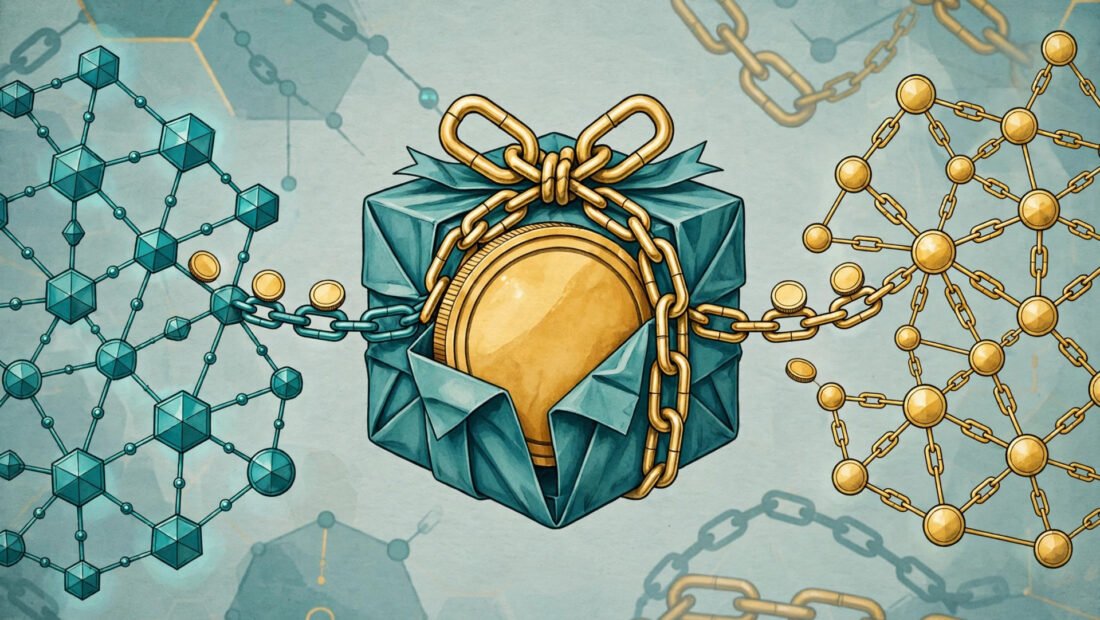
Wrapped tokens solve this with a simple idea: lock up the original coin in a secure vault, and issue a blockchain-native IOU token representing it on the other chain. The IOU — the “wrapped” version — can then be used freely in that chain’s apps, and it is redeemable 1:1 for the original coin at any time. It is conceptually identical to exchanging currency for a trip abroad: your pounds become euros for use in euroland, exchangeable back when you return — except here the “exchange bureau” is automated code or a regulated custodian.
How Wrapping Actually Works: The Two Models
Centralised (custodial) wrapping
The original and most widely used model, exemplified by Wrapped Bitcoin (WBTC). You send real Bitcoin to a custodian; the custodian locks it in reserve and mints an equivalent amount of WBTC tokens on Ethereum. Redeem the WBTC, and the custodian releases your Bitcoin and destroys (“burns”) the tokens. The peg holds because arbitrageurs keep it honest: if WBTC trades below Bitcoin’s price, traders buy cheap WBTC, redeem for Bitcoin, and profit — pushing the price back up.
The trade-off is trust: you rely on the custodian actually holding the reserves and honouring redemptions. Proof-of-reserve attestations and transparent audits mitigate this, but the model reintroduces the trusted third party that crypto was designed to avoid.
Decentralised (trustless) wrapping
Newer models replace the custodian with smart contracts and decentralised validator networks that collectively control the locked coins. No single company holds your Bitcoin; code and economic incentives do. This is philosophically purer but technically riskier — smart-contract bugs in bridge protocols have caused some of the largest hacks in crypto history, with hundreds of millions drained from wrapping bridges. The lesson: “trustless” does not mean “riskless”; it means the risk moved from custodians to code.
What You Can Do with Wrapped Tokens
Once wrapped, your Bitcoin can earn yield in Ethereum lending protocols, provide liquidity to decentralised exchanges, serve as collateral for loans, or be traded against thousands of tokens — all while maintaining exposure to Bitcoin’s price. For many holders, this was revolutionary: previously idle Bitcoin could suddenly work. The same applies across chains — wrapped versions of major coins exist on most significant blockchains, forming the connective tissue of the multi-chain ecosystem.
The Risks Nobody Should Ignore
Custodian risk. If the custodian is hacked, becomes insolvent or freezes redemptions, wrapped tokens can de-peg from the underlying asset. Your WBTC is only as sound as the vault behind it.
Bridge hacks. Decentralised wrapping relies on bridge contracts holding enormous locked value — prime targets. Multiple nine-figure bridge exploits have occurred; each one stranded wrapped-token holders.
De-pegging. In stressed markets, wrapped tokens can trade at discounts to the underlying coin — sometimes small and temporary, occasionally large. If you need to exit during a de-peg, you realise the discount.
Complexity and fees. Wrapping, unwrapping and moving between chains each cost fees and add steps where mistakes happen — wrong networks, wrong addresses, misunderstood processes.
Tax events. In the UK, wrapping crypto may count as a disposal for Capital Gains Tax purposes — exchanging one asset for another. HMRC’s cryptoassets guidance treats crypto-to-crypto exchanges as disposals, so wrapping is not the tax-neutral admin step many assume. Understanding how UK disposals and profits are taxed helps you account for wrapping properly rather than discovering the liability later.
How Long Does It Take to Really Understand Them?
Honestly? The core concept takes ten minutes: locked original, IOU token, 1:1 redeemability. Genuine understanding — enough to use wrapped tokens safely — takes longer: grasping the two wrapping models, their distinct risks, the tax treatment, and the practical mechanics of wrapping and unwrapping. Expect a few hours of reading and, ideally, a tiny test transaction before committing real sums. A good exercise: trace a real wrapped token on a blockchain explorer — watch the mint transaction, the reserve wallet, the redemption. Seeing the machinery in action converts abstract understanding into concrete confidence, and reveals exactly which custodian or contract your money would depend on.
Practical Rules for Using Wrapped Tokens
Prefer wrapped tokens from large, transparent, audited issuers with proof of reserves. Understand which model (custodial or decentralised) backs your token and what that implies. Never hold more in wrapped form than you can afford to have impaired by a custodian or bridge failure. Keep records of every wrap/unwrap for HMRC. And remember the FCA’s standing caution: these are experimental financial instruments in largely unregulated territory — size positions accordingly, and revisit your exposure whenever the issuer’s transparency or the broader market structure changes.
Conclusion
Wrapped tokens are an elegant solution to blockchains’ isolation: lock the original, issue a 1:1 IOU, unlock a universe of uses. Their risks — custodian failure, bridge hacks, de-pegging, tax surprises — are the price of that elegance. Understand the model behind your token, verify the reserves or code standing behind the peg, keep HMRC-grade records, and size your exposure to the risk. Do that, and wrapped tokens become what they were designed to be: a bridge between blockchains, not a plank you walk off.
Frequently Asked Questions
What is a wrapped token in simple terms?
A blockchain-native IOU: the original coin is locked in reserve, and an equivalent token is issued on another blockchain, redeemable 1:1. It lets (for example) Bitcoin be used inside Ethereum apps.
Is wrapped Bitcoin the same as Bitcoin?
In value (usually 1:1) but not in nature: WBTC is an Ethereum token backed by custodied Bitcoin, carrying custodian and smart-contract risks that native Bitcoin does not have.
Can wrapped tokens lose their peg?
Yes — custodian problems, bridge hacks or market stress can push wrapped tokens below the underlying asset’s price. Large, transparent issuers have the strongest peg track records.
Do I pay UK tax when wrapping crypto?
Possibly — HMRC generally treats crypto-to-crypto exchanges as disposals for Capital Gains Tax, and wrapping may qualify. Keep records and check HMRC’s guidance.
How do I unwrap tokens back to the original?
Through the issuer’s redemption process (custodial) or the bridge protocol (decentralised): you return the wrapped tokens, the reserve releases the original coins, and the wrapped tokens are burned. Each step costs network fees.