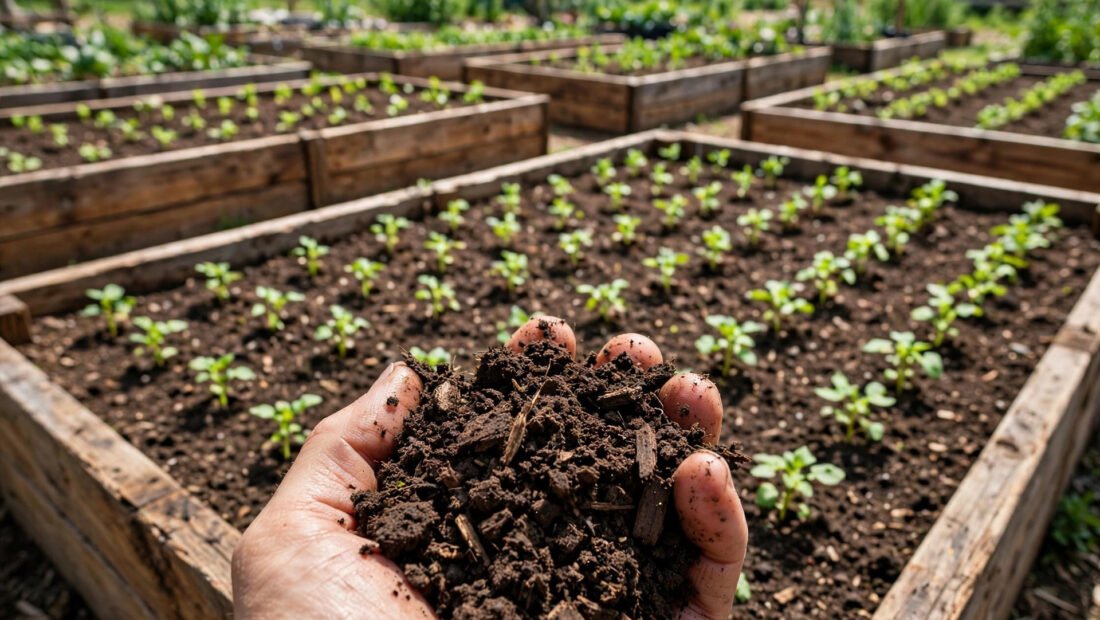
Raised beds are the great equaliser of British gardening. Whether your ground is Glasgow clay, Norfolk sand or a new-build plot compacted by diggers, a raised bed lets you start with perfect soil on day one. But “perfect” is where most beginners stumble: they fill their handsome new timber beds with whatever is cheapest at the garden centre, and then wonder why their carrots fork, their tomatoes sulk and everything dries out by July. Choosing the right soil for raised beds is the single highest-leverage decision you will make — more important than the timber, the position or even what you plant.
This guide explains exactly what to fill your raised beds with in the UK, when to choose which mix, what to avoid, and how to keep that soil superb year after year.
Why Raised Bed Soil Matters More Than You Think
Plants in raised beds live entirely on what you give them. Unlike open ground, where roots can wander metres in search of water and nutrients, a raised bed 20–30cm deep is a closed system. It drains faster than the surrounding soil — a blessing in wet winters, a curse in summer droughts — and its nutrient reserves are finite. The RHS estimates that a productive raised bed can lose most of its available nitrogen in a single heavy-cropping season, which is why the initial fill matters so much.
The other factor is UK weather. Our winters are wet enough to leach nutrients and compact poorly structured mixes, while our summers increasingly bring hot, dry spells. The ideal raised bed soil is therefore a balancing act: free-draining enough to survive a February deluge, yet moisture-retentive enough to carry tomatoes through August. No single bagged product achieves this perfectly, which is why blending is the professional approach.
The Three Components of a Perfect Raised Bed Mix
Think of raised bed soil as a recipe with three ingredients, each doing a distinct job:
1. The base: topsoil (roughly 50–60%)
Good screened topsoil provides the mineral backbone — the sand, silt and clay that give soil its body and hold nutrients. In the UK, look for topsoil certified to BS 3882, the British Standard for topsoil quality, which guarantees it has been tested for contaminants and texture. Avoid suspiciously cheap “topsoil” from unregulated sources; it can contain rubble, weed seeds and even contamination. For most beds, a sandy-loam topsoil is ideal. If you are building beds on a budget alongside other projects, our guide to starting a small vegetable garden in your UK backyard covers sourcing materials economically.
2. The life: organic matter (roughly 30–40%)
Compost, well-rotted manure or leaf mould is what makes soil alive. It feeds the microbial ecosystem, improves both drainage and water retention (remarkably, it does both), and releases nutrients slowly. Garden compost is free if you make it; well-rotted farmyard manure is cheap by the bulk bag. Mushroom compost is excellent but slightly alkaline, so avoid it for acid-lovers like blueberries. Never use fresh manure — it burns roots and is full of weed seeds. It must be at least a year old, dark, crumbly and sweet-smelling.
3. The drainage: grit or perlite (roughly 10%)
In our wet climate this is the ingredient beginners skip and later regret. A shovelful of horticultural grit or perlite per barrow of mix keeps the blend open and airy through winter, preventing the anaerobic slump that turns beds into cold, sour mud. This matters most for Mediterranean herbs, carrots and anything in a bed deeper than 30cm.
Bagged “Raised Bed Soil” — Worth It or a Rip-Off?
Garden centres now sell bags labelled “raised bed mix” or “vegetable planter soil,” typically 35–50 litres for £6–£10. For a single small bed these are convenient and the quality is generally decent — usually a blend of composted bark, coir and green waste compost with added fertiliser. But do the maths: a standard 1.2m × 1.2m bed at 25cm deep needs 360 litres, or roughly eight to ten bags — £60 to £100 per bed. Filling five beds this way costs more than the timber did.
The economical route is bulk delivery: a tonne bag (roughly 700–900 litres) of screened topsoil costs £60–£90 delivered in most of the UK, plus a bulk bag of compost or manure for £50–£80. That fills three to four beds for the price of filling one with bagged mix. The RHS raised bed guidance confirms that a topsoil-plus-compost blend performs as well as premium bagged mixes for a fraction of the cost.
What to Put at the Bottom of Deep Beds
For beds deeper than 30cm, filling the entire volume with premium mix is wasteful. The bottom third can be bulked out with coarse material: upside-down turf, logs and branches (the hugelkultur method), straw, or even shredded cardboard. These break down slowly, feeding the soil from below while saving you a fortune. One caution: fresh wood at the bottom can temporarily lock up nitrogen, so keep a 15cm buffer of proper mix between the woody layer and your planting depth. Never put rubble, gravel or plastic at the bottom — the old “drainage layer” myth actually impedes drainage by creating a perched water table, as soil scientists have demonstrated for decades.
Adjusting the Mix for What You Grow
Different crops want slightly different soils, and once your beds are built, tailoring beats rebuilding:
Root vegetables (carrots, parsnips) want the sandiest, stone-free mix you can make — sieve the top 20cm through a 1cm mesh and add extra grit. Forked carrots are almost always caused by stones or fresh manure, not bad luck.
Hungry crops (tomatoes, courgettes, brassicas, sweetcorn) want the richest mix: extra compost and a handful of organic fertiliser per square metre at planting time.
Mediterranean herbs (rosemary, thyme, lavender, sage) want lean, gritty soil — cut the compost by half and double the grit. Rich soil makes them lush, floppy and less fragrant.
Blueberries and acid-lovers need ericaceous compost and a pH below 5.5 — they will not thrive in standard mixes anywhere in the UK.
Maintaining Raised Bed Soil Year After Year
Raised bed soil sinks — expect the level to drop 3–5cm per year as organic matter decomposes. Every autumn or spring, top up each bed with 3–5cm of compost or well-rotted manure: the classic “no-dig” top-dressing. This single habit maintains fertility, structure and microbial life with almost no effort. The charity Garden Organic recommends exactly this annual top-dress as the backbone of organic bed management.
Rotate your crops to prevent pest and disease build-up — our explainer on making your garden look its best touches on planning, but for beds specifically, follow the classic four-year rotation: roots, then brassicas, then legumes, then potatoes/squash. Finally, never leave beds bare over winter in our climate: sow green manures like winter rye or field beans, or simply mulch thickly. Bare soil in a British winter loses nutrients to leaching and structure to rain impact — a covered bed wakes up in spring ready to grow.
Conclusion
The best soil for UK raised beds is not a product you buy but a blend you build: roughly half good screened topsoil, a third rich organic matter, and a tenth grit for drainage, bulked at the bottom for deep beds and topped up with compost every year. Get this right and your beds will out-produce open ground for years; get it wrong and no amount of feeding later fully compensates. Spend the money on the fill, not just the frame — the soil is the garden.
Frequently Asked Questions
How much soil do I need for a raised bed?
Multiply length × width × depth in metres to get cubic metres, then multiply by 1,000 for litres. A 1.8m × 0.9m bed at 0.25m deep needs about 405 litres — roughly half a bulk bag of topsoil plus a quarter bag of compost.
Can I use garden soil from elsewhere in my garden to fill raised beds?
Yes, if it is decent loam — but sieve out stones, roots and perennial weeds first, and blend it 50:50 with compost. Do not use heavy clay subsoil or soil from under old paths; it compacts badly in beds.
Should I line the bottom of my raised beds?
No liner is needed on soil — roots should reach through into the ground below. Only line the sides if using treated timber (to slow chemical leaching) and never line the bottom with plastic, which traps water. Cardboard on weedy ground beneath the bed is fine.
How often should I replace raised bed soil completely?
Almost never, if you maintain it. Annual compost top-dressing, crop rotation and green manures keep beds productive indefinitely. Only replace soil if it becomes contaminated or severely diseased (e.g. persistent clubroot), which is rare.