Jet lag is the tax on long-haul travel — and most of us pay it badly, losing days to grogginess. If you’re asking how can I beat jet lag on a long haul flight from the UK, here’s the science-backed playbook: what to do before, during and after the flight, and why most advice you’ve heard is half-right.
Understanding Jet Lag (60 Seconds of Science)
Jet lag is your circadian clock disagreeing with local time. Key facts: eastward is worse (losing hours is harder than gaining — UK to New York’s return leg hurts more than the outbound); recovery takes ~1 day per hour of time difference (a 5-hour shift = ~5 days to fully adjust, though you’ll feel functional sooner); light is the master switch — light exposure resets your clock faster than anything else; and age matters — over-40s typically feel it more. Everything below works with this biology, not against it.
Before the Flight: Pre-Shift Your Clock
Start 2-3 days before departure: flying east (UK to Asia/Australia): go to bed and wake 1 hour earlier each day; seek bright light in the morning. Flying west (UK to the Americas): shift bedtime 1 hour later daily; seek evening light. Even a 2-hour pre-shift halves the adjustment. Apps: Timeshifter (free for basic use) generates a personalised light/sleep/caffeine schedule — it’s based on real circadian science and genuinely works. Sleep well the nights before — starting sleep-deprived multiplies jet lag.
During the Flight: The Strategy
- Set your watch to destination time immediately — start living on it: eat and sleep by the new clock, not the old.
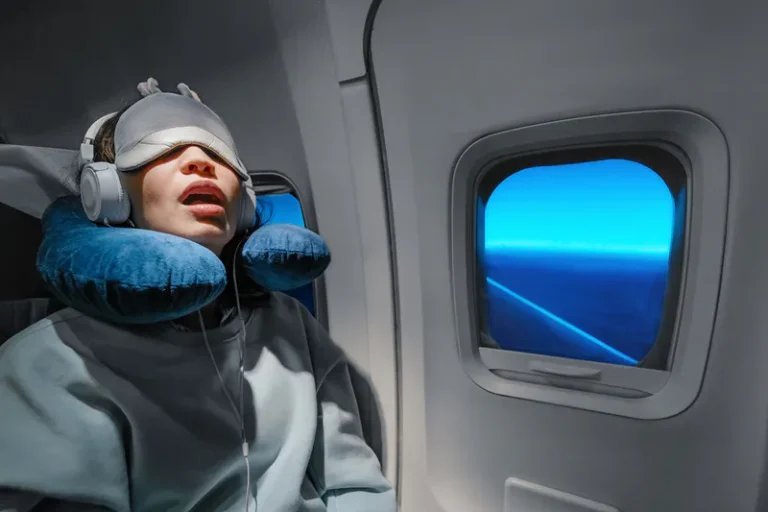
- Sleep strategically: if it’s night at your destination, sleep (eye mask, earplugs, neck pillow — the £30 kit that matters). If it’s daytime there, stay awake — films, reading, walking the aisle. This is the single most impactful in-flight action.
- Hydrate aggressively: cabin air is drier than desert — drink water constantly, limit alcohol (it fragments sleep and dehydrates; one drink with dinner, not five), go easy on caffeine (useful strategically, harmful randomly).
- Move: walk every 2-3 hours, do seat exercises, wear compression socks on 8+ hour flights — comfort and circulation both help arrival condition.
- Melatonin: the evidence-backed supplement — 0.5-3mg taken at destination bedtime for 2-3 nights helps reset the clock (it’s a timing signal, not a sedative; more isn’t better). Available over the counter in the US, pharmacy-only in the UK — ask your pharmacist. Not for children/pregnant women without medical advice.
After Landing: The Light Protocol
This is the part that actually fixes jet lag:
- Flying east (need to advance your clock): seek bright light in the morning (go outside before 10am local), avoid bright light in the evening (sunglasses after 4pm for the first days).
- Flying west (need to delay your clock): seek bright light in the late afternoon/evening, avoid morning light (sunglasses till midday).
- Get outside: daylight is 10-100x stronger than indoor light — a 30-minute morning walk beats any lamp.
- Exercise: morning exercise advances the clock (good for eastward); evening exercise delays it (good for westward). Either way, move on day one.
- Eat on local time: meals are secondary clock-setters — eat at local mealtimes even if you’re not hungry.
- The nap rule: if you must nap, 20-30 minutes max, before 3pm local. Longer/daytime naps destroy nighttime sleep and extend jet lag by days.
- Caffeine curfew: none after 2pm local for the first few days — it has a 6-hour half-life working against your new bedtime.
What Doesn’t Work (Myths)
- “Power through without sleep”: total sleep deprivation makes day one miserable and doesn’t speed adjustment.
- Sleeping pills: they sedate, don’t reset — you wake groggy on the wrong clock. (Melatonin is different — it’s a clock signal.)
- Hydration alone: helps comfort, doesn’t fix the clock. Necessary but not sufficient.
- Alcohol as a sleep aid: fragments sleep architecture — you’ll sleep, badly, and wake worse.
- One weird trick: fasting protocols (“Argonne diet”) have thin evidence; light timing has strong evidence. Follow the light.
Trip-Specific Advice
- Short trips (2-3 days): don’t fully adjust — stay on home time if possible (keep UK sleep hours, use light to maintain). Common for business trips.
- East coast USA (£5 hours): see cheap NYC flights — the classic: arrive morning, stay up all day, crash at 9pm local.
- Asia (7-8 hours): the tough one — pre-shift 3 days, aggressive morning light on arrival, melatonin at local bedtime.
- Australia (9-11 hours): nearly inverted — treat as a full reset; give it a week; the light protocol matters most here.
For the flight itself, see Heathrow timing and flying with a baby (jet lag × baby = advanced mode).
Jet Lag With Kids (Advanced Mode)
Children adjust faster than adults — but the transition days test everyone: babies/toddlers: shift their schedule 1 hour/day for 3 days before travel; on arrival, get them into daylight immediately and keep them up till local bedtime (the park, not the hotel room). Expect 2-3 rough nights; it passes. Older kids: explain the plan (“we’re staying up till 8pm local time, then bed”), use morning light and activity, avoid letting them nap past 3pm. Feeding: eat on local time from landing — hunger is a clock-setter for kids too. Be kind to yourselves: plan light first days (see flying with a baby and toddler holidays for the broader survival guides). The family that naps together at 2pm stays jet-lagged together — push through as a team.
The Frequent Flyer’s Toolkit
For those who do this monthly: Timeshifter app (the gold standard — personalised protocols per trip), quality sleep kit (moulded earplugs, contoured eye mask, travel pillow you actually like — £50 total, used 50x/year), melatonin routine (consistent timing matters more than dose), exercise on arrival (non-negotiable — even 20 minutes), strategic caffeine (morning only, local time), and protecting home sleep between trips (the baseline matters). Frequent flyers who systematise this report jet lag as a minor nuisance, not a trip-ruiner — it’s a skill, and like all skills, it improves with deliberate practice.
The NHS’s advice on staying healthy when flying covers sleep, hydration and circulation — the foundations jet-lag tactics build on.
The Practical Takeaway
Beat jet lag with: pre-shifting your sleep 2-3 days before, sleeping/waking on destination time during the flight, the light protocol on arrival (morning light eastward, evening light westward), the 20-minute nap rule, melatonin at local bedtime, and no caffeine after 2pm. Light is the master switch — everything else is support. Do this and you’ll lose a day to jet lag, not a week.