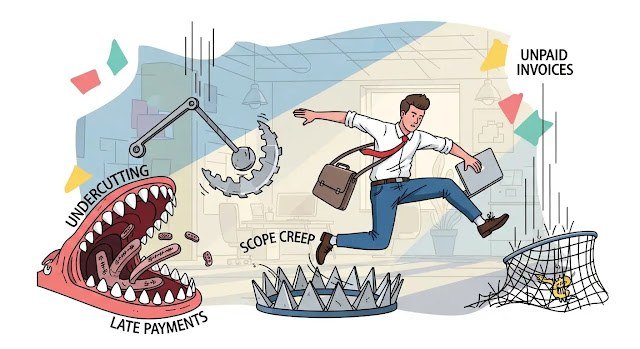
Here’s the thing about how do i handle late paying clients as a uk freelancer: most of the advice online is either written for Americans or quietly trying to sell you something. Neither is much use when you’re standing in a UK shop or staring at a UK website trying to make a decision.
So this is the straight version. No jargon, no affiliate-fuelled nonsense, just what I’d tell a mate who asked me down the pub. The Late Payment of Commercial Debts Act lets you charge interest at 8% over base rate, and once you know that, the rest of the decision gets a lot easier. Here’s everything worth knowing.
I’ve assumed you’re starting from scratch, so no prior knowledge needed. If you already know the basics, skim the first couple of sections and jump straight to the practical walkthrough further down.
How do i handle late paying clients as a uk freelancer
Cutting straight to it: The Late Payment of Commercial Debts Act lets you charge interest at 8% over base rate. There, that’s the headline. Set clear 30-day payment terms in writing before the work starts.
Of course the headline never tells the whole story. Your specific situation changes the maths: where you live, how much hassle you’ll tolerate, and whether you’re optimising for price, convenience or peace of mind. The sections below walk through each of those properly.
There’s no single right answer here, only trade-offs. The people who end up happiest are the ones who match the solution to their actual situation rather than chasing whatever’s fashionable. Keep your own priorities front and centre as you read on.
How this works in practice
Let’s talk about the bit nobody mentions. Ask for a deposit or staged payments on larger projects. Once that clicks, a lot of the confusing advice out there suddenly makes sense, and you can filter the useful from the noise.
And while we’re at it: A polite but firm chase sequence beats awkward silence every time. If that’s useful, our guide to How long does it take to dissolve a limited company in the uk digs into the next question you’ll probably have. It is one of those small things that makes a disproportionate difference to the outcome.
The practical bit: what to do about it
Enough theory. Here’s how to actually deal with it, in order:
- Set clear 30-day payment terms in writing before the work starts.
- Ask for a deposit or staged payments on larger projects.
- A polite but firm chase sequence beats awkward silence every time.
- Invoice finance or factoring can bridge the gap while you wait.
- Firing a persistently late payer is often the most profitable decision.
Work through those and you’re in better shape than the vast majority of people dealing with this.
Where people usually go wrong
Steer clear of these and you’ll already be ahead:
- Skipping written terms because it feels awkward to ask for them.
- Mixing personal and business money from day one.
- Invoice finance or factoring can bridge the gap while you wait.
- Firing a persistently late payer is often the most profitable decision.
The part people usually skim past
It’s worth lingering on one point: Ask for a deposit or staged payments on larger projects. This matters more than it first appears, because it’s the detail that decides whether you’re still happy in six months or quietly regretting the choice. Plenty of guides gloss over it in a sentence; I’d rather you actually absorbed it.
Similarly: Firing a persistently late payer is often the most profitable decision. Put those two together and the picture gets much clearer than the headline question suggests. Your exact situation will shift the details, but the principle holds: get these two things straight and the decision practically makes itself.
Three quick things to keep in your back pocket while you decide:
- Remember: Set clear 30-day payment terms in writing before the work starts.
- Don’t forget: A polite but firm chase sequence beats awkward silence every time.
- And finally: Invoice finance or factoring can bridge the gap while you wait.
None of this is meant to put you off, quite the opposite. Knowing the awkward bits in advance is what lets you sidestep them entirely. Most people who have a bad experience here skipped exactly this kind of detail and paid for the lesson afterwards.
What you’ll actually pay
On the money side, here’s the realistic picture: The Late Payment of Commercial Debts Act lets you charge interest at 8% over base rate. On top of that, Invoice finance or factoring can bridge the gap while you wait.
The other thing to budget for is your own time. The cheapest route often involves the most faff, and there’s a point where paying a bit more for someone competent to just handle it is the rational choice. That’s not laziness, it’s maths.
And don’t be shy about haggling or shopping around. In the UK, a surprising number of providers will match a competitor’s quote or throw in extras if you simply ask. The worst they can say is no, and you’ll never know unless you try.
And if you’d like a second opinion from somewhere authoritative, the official GOV.UK guidance covers this well.
A couple of questions that come up a lot:
What’s the single most important thing to get right?
The Late Payment of Commercial Debts Act lets you charge interest at 8% over base rate. Honestly, most people overthink this part. Pick the sensible middle option and move on with your day.
Is the cheapest option ever the right one?
Firing a persistently late payer is often the most profitable decision. Put simply, don’t rush it; the right choice is usually obvious once you’ve compared two or three options side by side.
What would you personally do here?
Ask for a deposit or staged payments on larger projects. Put simply, don’t rush it; the right choice is usually obvious once you’ve compared two or three options side by side.
The bottom line: If I had to boil it down to one sentence: The Late Payment of Commercial Debts Act lets you charge interest at 8% over base rate, so start there and don’t overthink the rest. Worth a read next: What happens if my ltd company makes no profit in a year. Also relevant: How do i close a business bank account i no longer need.