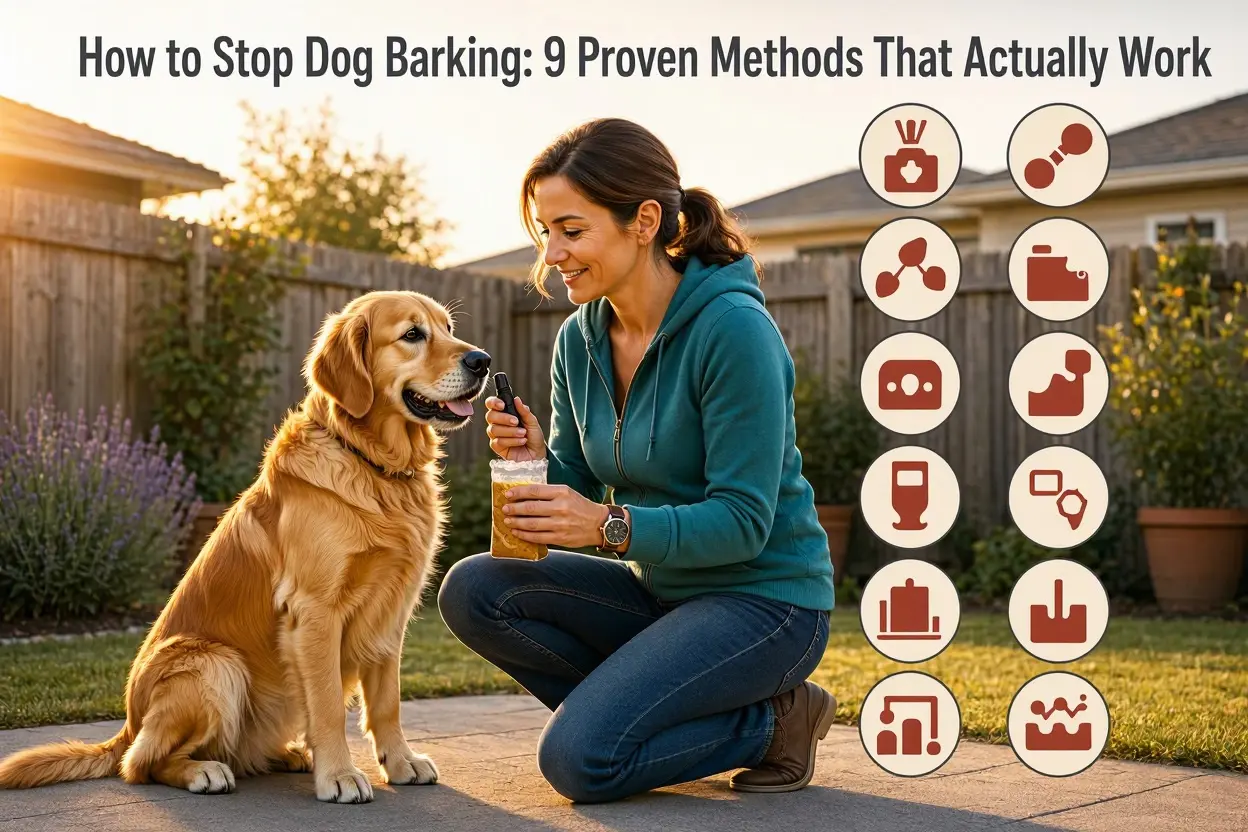
Quick answer: To stop dog barking, first find out why your dog is barking. Then remove the trigger, teach a “quiet” command, reward calm behavior, and give your dog enough exercise and mental stimulation. Punishment and yelling make barking worse.
Barking is normal. It is how dogs talk. But constant barking can stress you out, annoy neighbors, and even become a legal problem. The good news is that how to stop dog barking is a skill you can teach with patience and the right method. This guide shows you how, step by step.
Why Do Dogs Bark So Much?
You cannot fix barking until you know the reason. Most dogs bark because of:
- Alert or territorial barking: strangers, delivery people, or noises outside
- Boredom: not enough exercise or things to do
- Attention seeking: the dog learned that barking gets a reaction
- Fear or anxiety: loud sounds, new places, or unfamiliar people
- Separation anxiety: barking when left alone
- Excitement or greeting: at play time, walks, or when you come home
- Pain or age-related changes: especially if barking suddenly increases
Watch when and where your dog barks. The pattern usually tells you the cause.
Method 1: Never Yell Back
When you shout, your dog often thinks you are joining in. Stay calm and use a low, steady voice. Calm energy teaches your dog that there is nothing to worry about.
Method 2: Remove or Reduce the Trigger
Sometimes the simplest fix is to block what makes your dog bark.
- Close the curtains or use frosted window film if your dog barks at people outside
- Move your dog’s bed away from the window or front door
- Use white noise or soft music to cover outside sounds
- Keep your dog away from the fence line during busy times
Method 3: Teach the “Quiet” Command
This is one of the most effective ways to stop a dog from barking.
- Wait for your dog to bark (or trigger it with the doorbell).
- Let them bark two or three times.
- Say “Quiet” in a calm, clear voice.
- Hold a treat near their nose. Most dogs stop barking to sniff.
- The moment they are quiet, say “Yes!” and give the treat.
- Slowly increase the time of silence before rewarding.
Practice for 5 minutes a few times a day. Never give the treat while the dog is still barking, or you will reward the barking.
Method 4: Reward Calm Behavior
Many owners only notice their dog when it barks. Flip that. Give treats, praise, or attention when your dog is quiet and relaxed. Dogs repeat what pays off.
Method 5: Ignore Attention-Seeking Barking
If your dog barks to get food, play, or attention:
- Do not look at, talk to, or touch your dog while they bark
- Wait for even a few seconds of quiet
- Then reward immediately
Expect the barking to get worse for a few days before it improves. This is normal and is called an “extinction burst.” Stay consistent.
Method 6: Give Enough Exercise and Mental Stimulation
A bored dog is a noisy dog. Most barking problems improve when dogs get:
- Daily walks (at least 30 to 60 minutes for most breeds)
- Puzzle toys and food-dispensing toys
- Chew toys and safe bones
- Short training sessions
- Sniff walks and playtime
A tired dog is a quiet dog.
Method 7: Fix Specific Barking Problems
How to Stop Dog Barking at Strangers or at the Door
- Teach your dog to go to a mat or bed when the doorbell rings
- Ask a friend to ring the bell repeatedly while you reward calm behavior
- Practice until the doorbell means “go to your spot” instead of “bark”
How to Stop Dog Barking at Night
- Exercise your dog well in the evening
- Keep a fixed bedtime routine
- Make the sleeping area dark, quiet, and comfortable
- Rule out hunger, thirst, or needing a toilet break
- For puppies, keep the crate near your bed at first
How to Stop Dog Barking When Left Alone
- Practice short absences and slowly make them longer
- Leave a puzzle toy or a treat-filled toy when you go
- Keep leaving and coming back very calm and boring
- Do not punish the dog for barking while you are away
If the barking comes with drooling, destruction, or panic, it may be separation anxiety. Talk to a vet or a certified trainer.
How to Stop Dog Barking at Other Dogs or People on Walks
- Keep distance from the trigger at first
- Reward your dog for looking at the other dog and staying calm
- Slowly reduce the distance over many sessions
- Use treats your dog loves
How to Stop Puppy Barking
- Give plenty of naps, play, and chew toys
- Do not give in to demand barking
- Start “quiet” training early
- Socialize your puppy safely with people, sounds, and other dogs
Method 8: Be Careful With Anti-Bark Tools
Many people search for a bark collar first, but not all are safe.
- Avoid shock collars. They can increase fear and anxiety and may make behavior worse.
- Citronella and ultrasonic devices work for some dogs but do not fix the cause.
- Positive training gives longer-lasting results with no fear.
If you consider any tool, ask a vet or professional trainer first.
Method 9: Get Professional Help
See your vet or a certified trainer if:
- Barking started suddenly with no clear reason
- Your dog seems in pain, confused, or older
- Barking comes with aggression, panic, or destructive behavior
- Home training has not worked after several weeks
A vet can rule out health problems, and a trainer can build a plan for your dog.
Common Mistakes That Make Barking Worse
- Yelling or punishing the dog
- Giving attention, food, or toys while the dog is barking
- Being inconsistent (allowing barking sometimes, not others)
- Not giving enough exercise
- Expecting results in one day
How Long Does It Take?
Most dogs show improvement within 2 to 6 weeks of daily, consistent training. Anxiety-related barking can take longer. Be patient and celebrate small wins.
Conclusion
Learning how to stop dog barking is about understanding your dog, not silencing them. Find the trigger, stay calm, teach the “quiet” command, reward peace, and keep your dog exercised and happy. With consistency and patience, you will have a calmer home and a happier dog.
FAQs
1. What is the fastest way to stop a dog from barking?
There is no instant fix, but the fastest reliable method is to remove the trigger and teach the “quiet” command with treats. Most dogs improve within a few weeks of daily practice.
2. Why does my dog bark at nothing?
Dogs hear and smell far better than humans, so they often react to sounds or scents you cannot notice. Boredom, anxiety, or age-related changes can also cause it. If it is new or constant, check with your vet.
3. How do I stop my dog from barking at night?
Give enough exercise in the evening, keep a calm bedtime routine, and make the sleeping area quiet and comfortable. Check that your dog is not hungry, thirsty, or needing to go outside.
4. How do I stop my puppy from barking?
Give your puppy enough play, naps, and chew toys, and do not reward demand barking. Start teaching “quiet” early and reward calm moments.
5. Should I yell at my dog to stop barking?
No. Yelling often sounds like barking to your dog and can raise their excitement or fear. Use a calm voice and reward quiet behavior instead.
6. Do bark collars work?
Some collars interrupt barking, but they do not fix the reason behind it, and shock collars can cause fear and stress. Positive training and a professional trainer are safer and more effective.
7. How do I stop my dog from barking when I leave?
Practice short absences, give a puzzle toy, and keep departures calm. If the dog panics, drools, or destroys things, it may be separation anxiety, so ask your vet or a trainer for help.
8. How do I stop my dog from barking at other dogs?
Keep enough distance at first, reward calm looks at the other dog, and slowly get closer over several sessions. Do not force greetings.
9. Does exercise really reduce barking?
Yes. Dogs with enough physical and mental exercise are calmer and bark less out of boredom or excess energy.
10. When should I see a vet or trainer about barking?
See a vet if barking starts suddenly, or a trainer if it comes with aggression, anxiety, or does not improve after several weeks of consistent training.