Twenty minutes a day does not sound like enough to learn the piano. It sounds like the consolation prize for people too busy for “real” practice. But the science of skill acquisition says otherwise: short, focused, daily practice beats long, occasional sessions for building the neural pathways that make playing automatic. Twenty deliberate minutes, every day, will take a complete beginner surprisingly far — if those minutes are spent on the right things.
This guide is the easiest effective way to learn piano on 20 minutes a day: what to practise, in what order, and how to make those minutes count.
Why 20 Minutes Daily Beats 2 Hours Weekly
Motor learning runs on sleep. When you practise, your brain flags the new patterns; overnight, sleep consolidates them into lasting skill. Practising daily gives your brain seven consolidation cycles a week; practising once gives it one. This is why the daily 20-minute practicer overtakes the weekend warrior within a month, despite fewer total hours.
The constraint also forces focus. Twenty minutes cannot be wasted on noodling — every minute needs a job. That discipline, paradoxically, makes short sessions more productive per minute than long ones, where attention fades and bad repetitions creep in. The rule: protect the streak. A missed day breaks consolidation momentum; a short session on a busy day keeps it alive. Ten minutes beats zero, always.
What You Need to Start
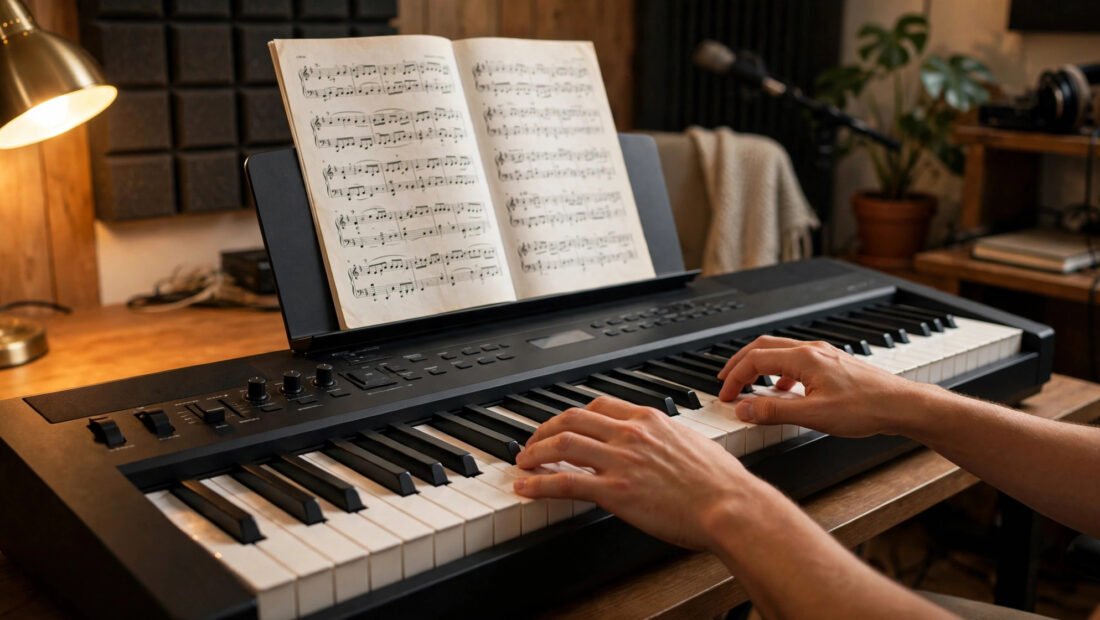
You need 88 weighted keys ideally — but to start, any touch-sensitive keyboard with at least 61 keys works. In the UK, decent beginner digital pianos start around £250–£350 (Yamaha P-45, Roland FP-10); a basic 61-key touch-sensitive keyboard costs £100–£150 and is fine for the first 6 months. Avoid non-touch-sensitive keyboards: without dynamic response, you cannot learn expression, and you will develop flat, lifeless technique.
Set up properly: bench at a height where your forearms are roughly parallel to the floor, feet flat, sitting far enough back that your elbows are slightly in front of your body. Bad setup causes tension that becomes injury — the NHS guidance on repetitive strain injury applies to pianists too. You do not need a teacher to start, though a single introductory lesson to check posture and hand position prevents months of bad habits.
The 20-Minute Session, Structured
Minutes 1–4: warm-up. Play five-finger patterns (C-D-E-F-G up and down) with each hand separately, then together, slowly. Focus on even tone and relaxed shoulders — this is physical preparation, not a performance.
Minutes 5–10: technique. One scale per week (start with C major, then G, then F). Play it hands-separately first, then together, at a speed where every note is even. Add simple chord drills: play C, F, and G chords in sequence, the harmonic backbone of thousands of songs.
Minutes 11–18: repertoire. Work on one piece at a time, in small sections — never just play through from the start. Take the hardest 4 bars, loop them slowly until smooth, then expand. This “chunking” is how professionals practise; playing through whole pieces just rehearses your mistakes.
Minutes 19–20: fun. Play something you love, however badly. End every session with joy — it is what makes tomorrow’s session happen.
Month-by-Month: What 20 Minutes Builds
Month 1: note reading in the C position, five-finger patterns, simple melodies with one hand, then hands together on easy pieces. Goal: play a simple song hands-together. Month 2–3: major scales (C, G, F), primary chords, and pieces with basic left-hand accompaniment patterns. Goal: play 3–4 simple pieces confidently. Month 4–6: more keys, chord inversions, pieces with independent hand parts, and your first forays into playing from chord symbols (the skill behind playing pop songs). Goal: play recognisable pop songs from chord charts.
This timeline assumes genuine daily practice. Miss half your days and double the timeline — the maths of consolidation is unforgiving but fair. Apps like Simply Piano or Flowkey structure this progression well for self-learners, though they work best combined with the structured session above rather than as aimless entertainment.
Making the Minutes Count: Focus Rules
Four rules multiply your 20 minutes. Slow down: practise at half the speed you think you should; speed is a byproduct of accuracy. Isolate: the hard bars get 80% of your repertoire time; the easy bars take care of themselves. Listen: record yourself weekly — your ears lie in real time but tell the truth on playback. Vary: rotate your scale, your piece, and your chord drills weekly so practice stays fresh.
Protect the habit itself: same time daily (habit stacking — practise right after an existing routine), instrument always set up and visible (friction kills practice; a keyboard in a cupboard gets played never), and a simple log (dates and minutes — watching the streak grow is powerfully motivating). For more on the psychology, our guide to staying motivated with new habits covers the science of sticking with things — and finding cheap live gigs nearby gives you inspiring pianists to watch once your ears develop.
Playing with Others: The Fastest Accelerator
Everything in this guide gets easier the moment you play with other people. Duets with a friend (even a beginner friend), family singalongs where you accompany, and local jam sessions all force the skills that solitary practice cannot: keeping time with others, recovering from mistakes without stopping, and listening while playing. The social pressure is gentle but real — knowing someone is counting on your left hand makes you practise it.
Look for beginner-friendly opportunities: many areas have adult piano groups, church and community choirs need accompanists, and apps now match local musicians. Do not wait until you feel “ready” — playing with others at month three, however shaky, teaches more than six more months alone. And teach what you learn: showing a friend their first scale cements your own understanding in a way practice never does. Music is a social art; the sooner your 20 minutes connect to other humans, the faster and more joyful the progress.
Conclusion: Small Minutes, Compounding Returns
Twenty minutes a day works because skill compounds through daily consolidation, not marathon sessions. Structure those minutes — warm-up, technique, repertoire in chunks, fun — protect the streak, slow down, and listen to your recordings. In six months, you will play real music with both hands. The piano does not care how busy you are; it only cares that you show up. For structured milestones along the way, ABRSM’s graded piano syllabus gives adult beginners a clear path from first notes to Grade 1 and beyond. Show up daily, and it will teach you.
Frequently Asked Questions
Can I learn piano with only 20 minutes a day?
Yes. Daily short sessions leverage sleep consolidation to build skills efficiently. Most beginners reach simple hands-together pieces within 1–2 months and recognisable pop songs within 4–6 months on 20 focused minutes daily.
Do I need an 88-key piano to start?
Not immediately — a 61-key touch-sensitive keyboard works for the first 6 months. But avoid non-touch-sensitive keyboards, and plan to upgrade to 88 weighted keys as you progress.
Should I learn to read music or just play by ear?
Learn to read — it is slower at first but unlocks everything: classical pieces, structured learning, and communicating with other musicians. Chord symbols (for pop) are worth learning alongside, not instead.
How do I stay motivated practising piano?
Same time daily, instrument always visible, end each session with something fun, record yourself monthly to hear progress, and set process goals (practise daily) rather than outcome goals (play a hard piece).