Flat feet and running have a complicated relationship. You have probably been told you “need” stability shoes, motion control, orthotics — or that you should not run at all. The running shoe industry has spent decades selling correction to flat-footed runners, but the science has shifted considerably, and the “choose now or wait” question is really about whether you need special shoes before you start, or whether you can start in neutral shoes and adapt. Here is what the evidence actually says.
What Flat Feet Mean for Running (and What They Don’t)
Flat feet (pes planus) means your arches collapse under load — the whole sole contacts the ground. This is often accompanied by overpronation: the ankle rolling inward excessively during the stride. For decades, this was treated as a defect requiring correction. The modern understanding is more nuanced: flat feet are a normal variant — around 20–30% of adults have them — and many flat-footed runners run injury-free for decades in neutral shoes.
The key distinction is between asymptomatic flat feet (no pain, no injury history) and symptomatic ones (arch pain, shin splints, knee pain, plantar fasciitis linked to the mechanics). If you are asymptomatic, the evidence increasingly suggests you do not need “correction” — a large 2013 study of novice runners (Nielsen et al.) famously found that prescribing shoes based on foot type did not reduce injuries, and that pronation itself was a weak injury predictor. If you are symptomatic, support is worth exploring — but as one tool among several, not a magic fix. The NHS guidance on flat feet takes a similarly measured view: most cases need no treatment.
Choose Now: When to Get Fitted Immediately
Get proper running shoes now — before your first serious run — if: you have current foot, ankle, knee or shin pain; you are significantly overweight (extra load magnifies mechanical issues); you plan to run on hard surfaces (pavement punishes poor mechanics more than trails); or you are returning from a lower-limb injury. In these cases, a specialist fitting is genuinely valuable.
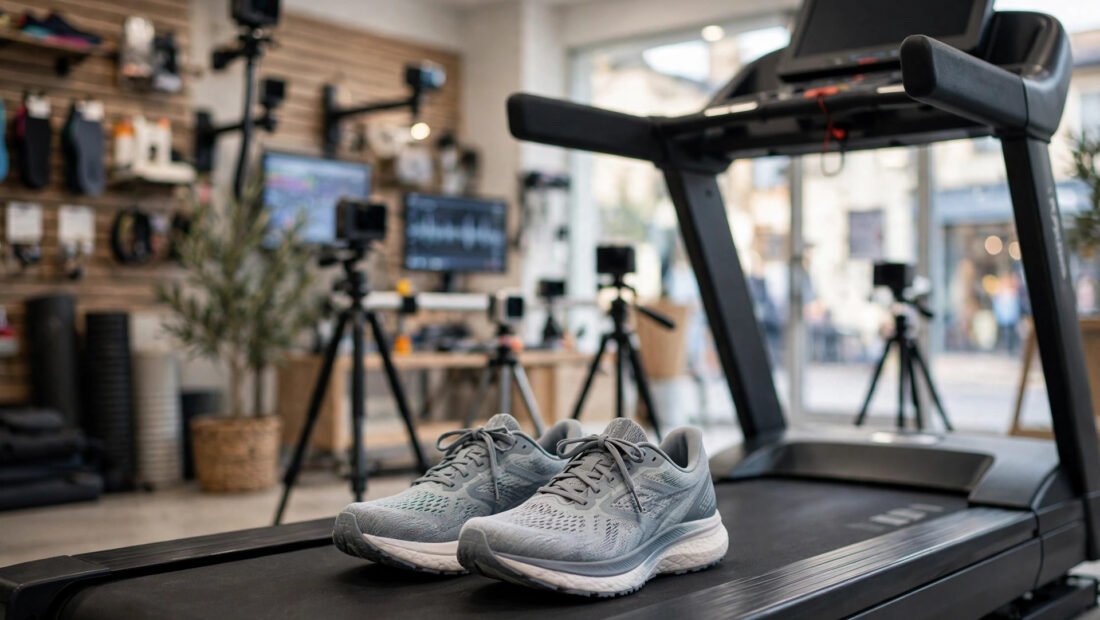
What a good fitting involves: gait analysis (filmed treadmill run, 10–15 minutes) at a specialist running shop — not a high-street sports chain — where the fitter watches your whole stride, not just your feet. Expect to try 4–6 pairs, to run in each, and to be asked about your history, mileage plans and surfaces. The right shoe feels comfortable immediately — the old “break them in” advice is dead; modern guidance says shoes should feel good from the first jog. Budget £80–£140 for quality daily trainers; cheap shoes are a false economy at higher mileages. And replace them every 500–800km — worn midsoles stop cushioning long before the uppers look tired. For the broader training picture, our guide to gym versus home exercise covers building fitness around your running.
Wait and See: When Neutral Shoes Suffice
If your flat feet are pain-free and you are starting from a low base (walking, couch-to-5K), you can reasonably start in a well-cushioned neutral shoe and monitor. The wait-and-see approach has real advantages: your feet strengthen with running (the intrinsic foot muscles adapt like any other), and prescribing heavy stability shoes to an asymptomatic runner can create dependence on support the foot would have developed naturally.
The monitoring protocol: run for 3–4 weeks, then assess — any new arch, shin, knee or hip pain? Check wear patterns on the soles (extreme inner-heel wear suggests meaningful overpronation). If pain appears, get fitted; if not, carry on. Many flat-footed runners discover their feet are simply feet — variant, functional, and fine. Strength work accelerates this: barefoot balance exercises, towel scrunches, calf raises and short-foot exercises (doming the arch without curling the toes) build the arch support your skeleton didn’t provide. Our guide to exercising with bad knees covers the strengthening approach that helps flat-footed runners too.
Transitioning Gradually: The Two-Week Rule
Whether you choose stability shoes now or neutral shoes to start, never debut new shoes on a long run. Alternate old and new pairs for the first two weeks, starting with short easy runs in the new pair, to let your feet and lower legs adapt to the different geometry. Runners who switch abruptly — especially to a more supportive or more minimal shoe — frequently develop calf, Achilles or arch soreness that mimics injury but is simply adaptation. If soreness appears, extend the transition; if sharp pain appears, the shoe is wrong regardless of category. Keep the old pair as a rotation option even after transitioning — rotating two pairs is associated with lower injury rates in several studies, possibly because it varies the loading patterns.
Stability vs Neutral vs Orthotics: Decoding the Options
Neutral cushioned shoes (e.g., Nike Pegasus, Brooks Ghost, Asics Gel-Nimbus): no corrective features, just cushioning. The default choice for asymptomatic flat feet — and increasingly the recommendation even for mild overpronators.
Stability/support shoes (e.g., Brooks Adrenaline, Asics GT-2000): medial posts or guide rails that resist inward roll. Worth trying if you overpronate and have symptoms — but buy for comfort, not for the category label. Many runners “need” stability on paper and run better in neutral.
Motion control shoes: the heaviest correction, now largely fallen from favour — stiff, heavy, and prescribed far less than a decade ago. Rarely the right first choice.
Orthotics/insoles: custom orthotics (£200–£400 via a podiatrist) help specific conditions (severe overpronation with pain, plantar fasciitis, posterior tibial tendon issues); over-the-counter insoles (£15–£30, e.g., Superfeet) are a cheap experiment worth trying before committing to custom. But insoles treat symptoms — pair them with the strengthening work above for lasting change. The Sports Injury Clinic’s runner resources detail the evidence for each option.
Conclusion
Should you choose running shoes for flat feet now or wait? If you have pain, extra load, hard surfaces or injury history — choose now, with a specialist gait analysis, buying for immediate comfort. If your flat feet are pain-free and you are starting gently — start in cushioned neutral shoes, strengthen your feet, and monitor for symptoms. Either way, the shoe is the least important part of the equation: gradual mileage progression, strength work and listening to pain signals matter far more than anything strapped to your feet. Flat feet are not a defect to correct — they are a variant to manage, and most manage just fine.
Frequently Asked Questions
Can you run with flat feet?
Absolutely — 20–30% of adults have flat feet and many run injury-free for years. Pain-free flat feet need no special treatment beyond sensible shoes and gradual progression; only symptomatic cases need intervention.
Do flat feet need stability running shoes?
Not necessarily. Research shows prescribing shoes by foot type doesn’t reliably prevent injury. Asymptomatic flat-footed runners often do best in neutral cushioned shoes; stability shoes are worth trying if you overpronate and have pain.
Are orthotics worth it for runners?
For specific painful conditions (plantar fasciitis, severe symptomatic overpronation), custom orthotics help. For pain-free flat feet, they’re usually unnecessary — try over-the-counter insoles and foot-strengthening first.
How often should I replace running shoes?
Every 500–800km (300–500 miles). Midsoles lose cushioning long before uppers look worn — track mileage in an app, and replace at the first sign of new aches rather than waiting for visible breakdown.