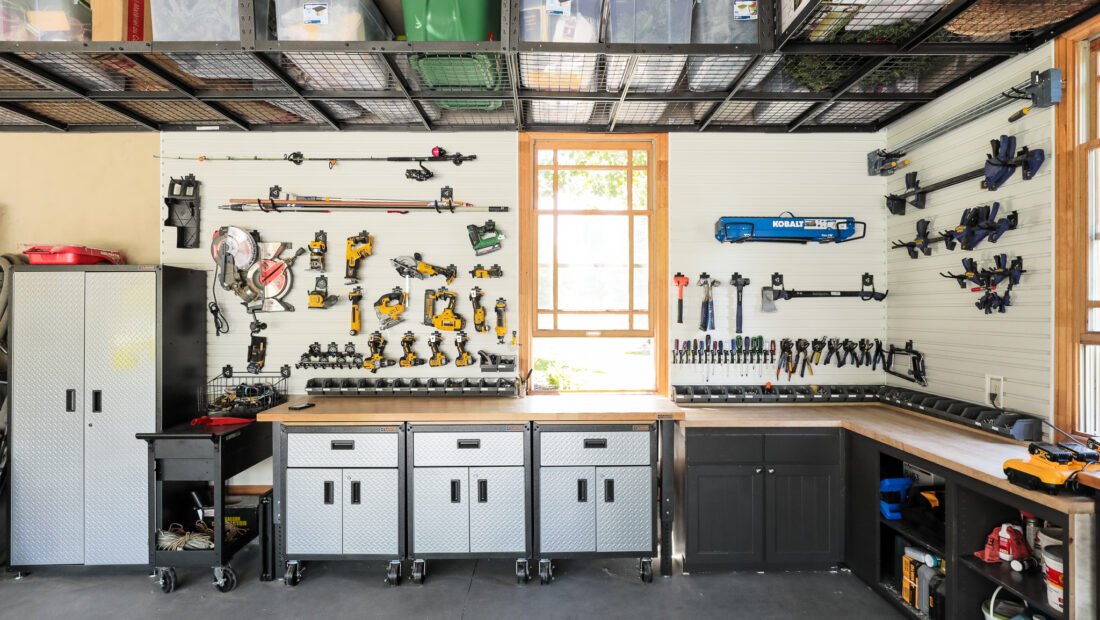
The small garage paradox: it’s supposed to store the car, the tools, the bikes, the lawnmower and twenty years of “might come in useful” — in a space barely bigger than a parking bay. Most small garages end up as chaotic cupboards where finding a screwdriver takes ten minutes. The fix isn’t a bigger garage; it’s using the walls, the ceiling and the vertical space you’re currently wasting. Here’s the best way to store tools in a small garage.
The best way to store tools in a small garage
The principle: everything off the floor
Floor space is the scarcest resource in a small garage. Every tool on the floor is space stolen from the car, the bike or your ability to walk. The hierarchy: walls first, ceiling second, floor last (and only for things that genuinely can’t go elsewhere).
Wall storage: the workhorse
- Pegboard (£15–£40): the classic for good reason — endlessly reconfigurable, everything visible, cheap. Metal pegboard outlasts hardboard in damp garages. Outline each tool’s position in marker pen and you’ll know instantly what’s missing.
- French cleats: the upgrade — angled timber battens on the wall with matching cleats on custom holders. Holds heavy tools securely, rearrange in seconds. A weekend project costing £20–£40 in timber.
- Heavy-duty shelving: for paint tins, boxes and bulky items. Fix into studs or masonry — our heavy shelf hanging guide covers the fixings (garage walls are often single-skin blockwork — use proper frame fixings).
- Magnetic strips (£8–£15): for screwdrivers, chisels, drill bits — grab-and-go accessibility.
- Wall-mounted tool cabinets: lockable, dust-free, professional. £60–£150 for a decent one.
Ceiling storage: the forgotten frontier
- Overhead racks (£40–£100): ceiling-mounted platforms for rarely-used items — camping gear, seasonal decorations, the roof box. Keeps bulk out of the way entirely.
- Bike hoists (£15–£30 each): pulley systems that lift bikes flat to the ceiling. In a small garage, bikes on the floor are the enemy — hoist them.
- Ladder hooks: ladders live on wall or ceiling hooks, never leaning in the corner eating a square metre.
Mobile and modular
- Rolling tool chest (£80–£200): mechanics-style chests keep hand tools organised and move to where the work is. Worth every penny if you actually use your tools.
- Stackable storage boxes: clear, labelled, uniform size. The uniformity matters — mismatched boxes waste space.
- Workbench with storage below (£100–£250): a folding or wall-mounted workbench gives you a work surface that disappears when the car needs the space.
Zoning: organise by task
The pros organise garages in zones, and it works in small spaces too:
- Daily grab zone (near the door): bike pump, basic tools, torch.
- Work zone (bench area): hand tools, power tools, fixings — everything within arm’s reach of the bench.
- Bulk zone (walls/ceiling): seasonal, rarely-used, bulky.
- Consumables zone (one shelf): paint, oils, cleaners, spare bulbs — together, labelled, findable.
Damp: the garage enemy
Most UK garages are unheated and many are damp — which rusts tools fast. Fight back:
- Ventilation: don’t seal a garage airtight; airflow prevents condensation.
- Tool protection: a light oil wipe on metal tools, silica gel packs in tool chests, and dehumidifier boxes (£5–£10) in cabinets.
- Raise everything: nothing directly on concrete floors — moisture wicks up. Even 5cm of clearance helps.
- Insulate if you work in there: if the garage doubles as a workshop, basic insulation and a small heater transform it — though check whether it needs to stay unheated for insurance purposes.
The great declutter
Be honest: half the stuff in the average garage hasn’t been touched in five years. Before buying storage, purge: broken tools (bin), duplicates (keep the best), “might be useful” timber offcuts (be ruthless — keep a small selection), dried-up paint tins (tip run — check your council’s hazardous waste rules). Storage systems organise what you keep; they can’t fix keeping everything. If the shed’s also overflowing, our shed guide helps decide what lives where.
The workbench: getting it right
A workbench is the heart of a working garage — and the most commonly botched purchase:
- Size: 120–150cm wide is the sweet spot for a small garage — enough for real work, not so much it eats the room. Depth 60cm.
- Height: 90cm for general work; your wrist crease standing up is the ergonomic measure. Too low ruins your back within an hour.
- Top: 30mm+ hardwood, beech block or doubled MDF — it needs to take hammering (literally). Replaceable sacrificial top layer is the pro move.
- Wall-mounted folding: the small-garage answer — a hinged bench that folds flat against the wall when the car needs the space (£80–£150, or buildable in a weekend). The workbench you can disappear is the workbench you’ll actually have room for.
- Vice: a 100–125mm engineer’s vice (£30–£60) bolted to the bench transforms what you can do. The single most useful workshop addition.
- Lighting: a bright LED batten (£15–£25) directly over the bench. You can’t do precise work in garage gloom.
Garage flooring: the foundation layer
- Bare concrete: free, dusty, stains permanently, cold. Seal it at minimum (£30–£60 for concrete sealer — kills the dust).
- Epoxy/paint: £50–£150 DIY for a single garage — transforms the look, resists oil, easy to sweep. Needs proper prep (degrease, etch) or it peels.
- Interlocking PVC tiles: £200–£500 — the premium DIY option. Tough, comfortable underfoot, replaceable individually, and they make a garage feel like a workshop rather than a cave.
- Rubber mats: £30–£80 — targeted: under the workbench, where you stand, where the bike drips. Cheap comfort.
And when the great declutter unearths the chemical graveyard (half-empty paint tins, ancient weedkiller, used oil), dispose of it properly — your council tip takes hazardous household waste for free, and Recycle Now tells you exactly where and what they accept. Don’t pour it down the drain or put it in the general bin.
The takeaway
Walls first (pegboard/French cleats), ceiling second (racks, bike hoists), floor last. Zone by task, fight damp with ventilation and oil, and declutter before you organise. A small garage can’t be big — but it can be ruthlessly efficient, and that’s better.