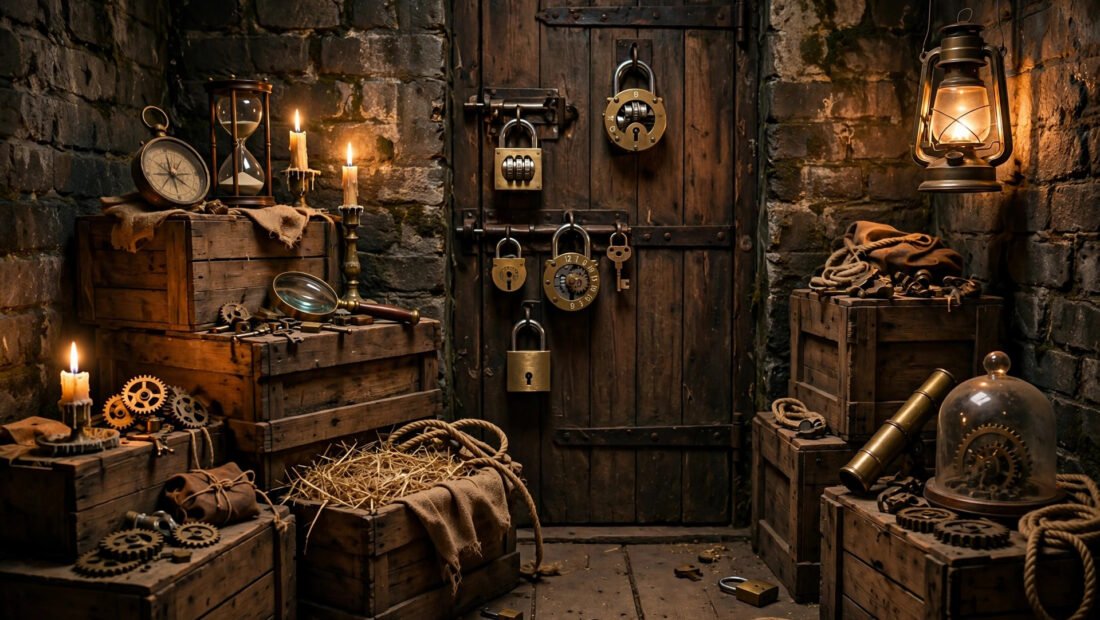
To design an escape room, start with a compelling theme and story, then build 5 to 8 varied puzzles that flow logically toward a final goal, all solvable within 60 minutes. A well-designed room balances challenge with fairness: every puzzle should be solvable from clues inside the room, and players should always know broadly what to do next.
Designing an escape room is part creative writing, part game design, and part practical engineering. Whether you are building a commercial venue or a one-off room for an event, the process follows the same logic: theme first, story second, puzzles third, and relentless playtesting last. Here is the complete step-by-step process used by professional designers across the UK.
Step 1: Choose a Theme That Sells Itself
Your theme is your marketing. The most successful UK escape rooms use themes players instantly understand: a Victorian detective’s office, a bank heist, a haunted manor, a laboratory containment breach, a pharaoh’s tomb. Pick a theme with strong visual potential and a natural reason for being locked in — a bomb to defuse, a cure to find, treasure to steal.
Avoid themes that require long explanations. If players need five minutes of briefing to understand the setting, the theme is working against you. Also consider your audience: family-friendly venues do best with adventure and mystery themes, while horror themes attract thrill-seekers but limit your market to adults.
Step 2: Write the Story and Set the Goal
Every great escape room has a narrative spine: who the players are, why they are locked in, and what they must achieve. Write this as a short paragraph first. For example: “You are detectives in 1890s London. Professor Blackwood has been murdered, and the killer returns in 60 minutes. Find the evidence and identify the murderer before they arrive.”
The story does three jobs: it motivates players, it justifies the puzzles (you are decoding the professor’s journal, not solving random sudoku), and it gives the finale emotional weight. Weave story beats through the room — a letter halfway through, a plot twist in the final puzzle — so the narrative unfolds as players progress rather than being dumped on them at the start.
Step 3: Design 5 to 8 Puzzles With Variety
Aim for 5 to 8 puzzles per 60-minute room. Fewer feels thin; more overwhelms most groups. Variety is critical — if every puzzle is a combination lock, the room feels repetitive. Mix puzzle types:
- Search puzzles — hidden compartments, UV torches revealing invisible ink, objects concealed in plain sight.
- Logic puzzles — ciphers, pattern sequences, riddles tied to the story.
- Physical puzzles — magnetic locks, weighted mechanisms, assembling objects.
- Observation puzzles — spotting differences, counting details in artwork, reading maps.
- Technology puzzles — RFID triggers, sound-activated locks, Arduino-controlled props.
- Teamwork puzzles — tasks requiring two or more players to cooperate, such as one person reading instructions another cannot see.
Design each puzzle backwards from its solution. Decide what the “aha” moment feels like, then build the clue chain that leads there. Every puzzle needs a clear entry point (how do players know to attempt it?), a logical solution path, and a satisfying payoff — usually unlocking something physical.
Step 4: Structure the Flow of the Room
How puzzles connect matters as much as the puzzles themselves. The three classic structures are:
- Linear: puzzles solve in sequence, one after another. Simple to follow and great for beginners, but a stuck team stalls completely and larger groups stand around.
- Open: several puzzles are available at once, and teams split up. Better for groups of 4 to 6, but harder to design so players know what to prioritise.
- Multi-linear: two or three puzzle paths run in parallel and converge at the finale. This is the professional standard — it keeps everyone busy while maintaining narrative momentum.
Whichever structure you choose, design the difficulty curve deliberately: an easy opening puzzle to build confidence, rising challenge through the middle, and a finale that combines elements from earlier puzzles for a satisfying climax.
Step 5: Build the Room and Dress the Set
Set design sells immersion. You do not need a Hollywood budget — clever lighting, paint effects, and second-hand furniture go a long way. Key principles: everything in the room should look like it belongs to the story, and anything that is not part of a puzzle should be clearly decorative or fixed down so players do not waste time on red herrings.
Install your puzzles with durability in mind. Commercial rooms run hundreds of groups a year; props will be pulled, twisted, and dropped. Use proper fixings, protect electronics, and build in redundancy — a puzzle that breaks mid-game ruins the experience and earns terrible reviews.
Step 6: Playtest Relentlessly, Then Playtest Again
No escape room is finished until strangers have played it. Run at least 10 to 15 playtests with people who were not involved in the design. Watch silently and take notes: where do they get stuck? Which puzzles do they solve instantly? Where do they misinterpret clues?
The most common design flaws playtesting reveals are puzzles with multiple plausible answers, clues that are too subtle to notice, and bottlenecks where the whole team waits on one task. Fix these ruthlessly. A good rule of thumb: if two separate groups struggle at the same point, the puzzle is wrong, not the players. After fixes, test again — and keep a log of completion rates and average finish times to calibrate difficulty.
Step 7: Sort the Practicalities: Safety, Costs and Legalities
Safety is non-negotiable. Players must always be able to exit quickly in an emergency — magnetic locks should release on fire alarm activation, and a games master should monitor every session via camera. Carry out a proper fire risk assessment, and check whether your local council requires any licensing for your premises. The Health and Safety Executive publishes guidance on managing risks in leisure settings that is worth reviewing.
On costs, a single professionally built room in the UK typically costs £10,000 to £50,000 to design and fit out, depending on how much technology you include. A DIY room for a party or school can be done for a few hundred pounds with second-hand props and combination padlocks. If you are opening commercially, read the official guidance on setting up a business in the UK to make sure you are covered on registration, insurance, and tax.
Pro Tips From Working Designers
- Limit red herrings — one or two decorative distractions are fine, but a room full of dead ends frustrates players.
- Make early puzzles physical and tactile; handling objects hooks players faster than reading.
- Hide hints in the room’s theming so your games master can nudge stuck teams without breaking immersion.
- Design for your target group size — a room built for 6 feels empty with 2 players.
- Photograph everything during the build; you will need the reference when props break and must be rebuilt identically.
Frequently Asked Questions
How much does it cost to design an escape room?
A commercial-quality room costs £10,000 to £50,000 to design and build in the UK. A home or party version can be created for £200 to £500 using padlocks, printed puzzles, and second-hand props. Technology — electronic locks, sensors, programmed effects — is what drives costs up.
How many puzzles should an escape room have?
Five to eight puzzles is the sweet spot for a 60-minute room. This gives a steady rhythm of roughly one solved puzzle every 7 to 10 minutes, which keeps energy high without overwhelming players.
How long does it take to design an escape room?
Expect 2 to 4 months from concept to opening for a single room, including design, build, and playtesting. Rushing the playtesting phase is the most common mistake — allow at least a month for testing and iteration.
Do I need planning permission to open an escape room?
It depends on the premises and its existing use class. Many escape rooms operate from former retail or office units, which may require a change of use. Contact your local council’s planning department before signing a lease, and check fire safety requirements with the local fire service.
Can I run an escape room from home?
For private parties and small events, yes — portable and pop-up escape rooms are a popular side business. For regular paying customers at your home, check your mortgage or tenancy terms, get public liability insurance, and confirm with your council whether business rates or licences apply.
The Bottom Line
Designing an escape room comes down to theme, story, varied puzzles, smart flow, and obsessive playtesting. Get those five elements right and the set dressing almost takes care of itself. Start small, test with real players, and iterate — the best rooms in the UK were not designed perfectly on paper, they were refined through dozens of groups finding every flaw you missed.