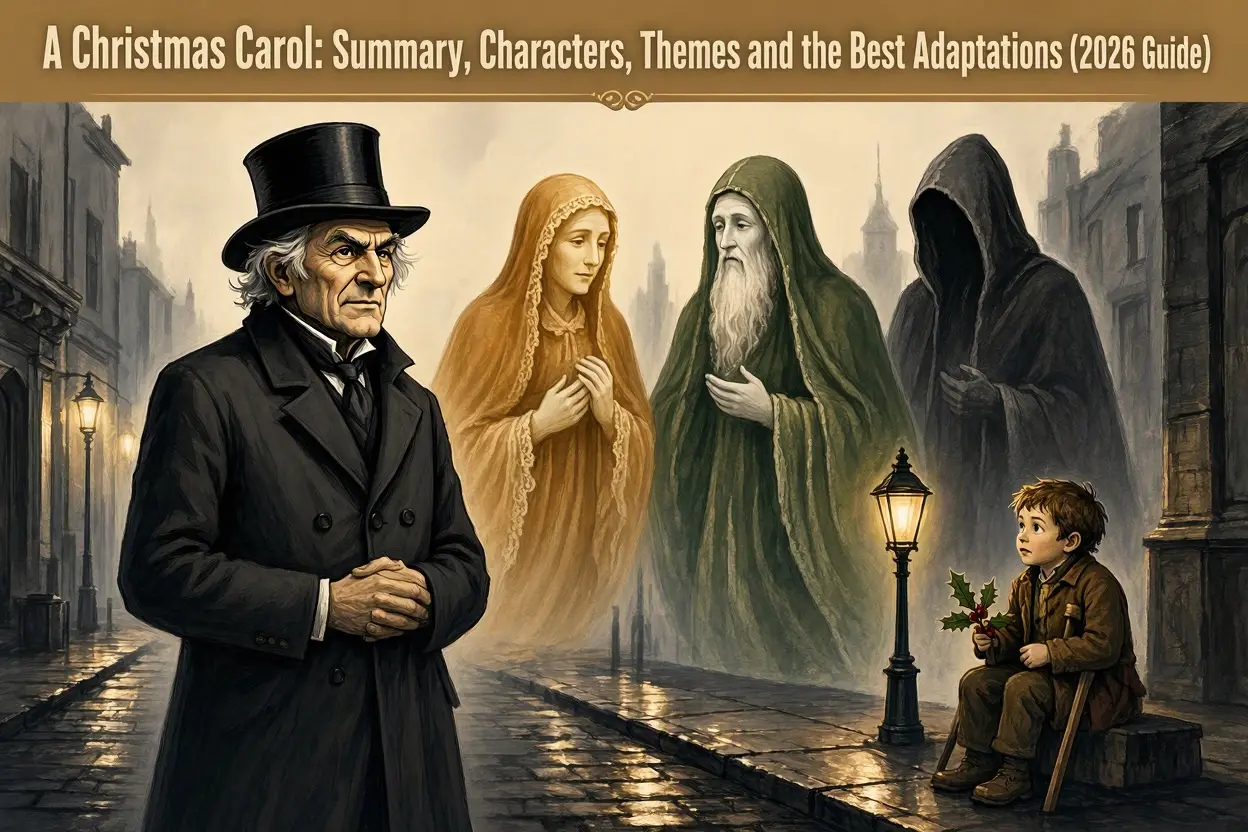
A Christmas Carol is one of the most famous stories in the English language. Written by Charles Dickens and first published in December 1843, it tells of a miserly old man who is transformed by a night of ghostly visits. Nearly two centuries later it is still read every winter, staged in theaters around the world and reinvented on screen, and 2026 brings a fresh wave of new versions.
This guide covers everything about A Christmas Carol: a plot summary, main characters, key themes, famous quotes, the best adaptations and what is new this year.
What Is A Christmas Carol?
A Christmas Carol is a novella by Charles Dickens, subtitled A Ghost Story of Christmas. It was published on 19 December 1843, was illustrated by John Leech, and is divided into five chapters that Dickens called “staves,” like the verses of a song. Its first print run sold out within days, and the book helped shape how many people imagine a warm, generous Christmas today.
The story follows Ebenezer Scrooge, a cold, greedy businessman in Victorian London who despises Christmas and cares only about money.
A Christmas Carol Plot Summary
(Spoilers ahead.)
Stave One: Marley’s Ghost. On Christmas Eve, Scrooge refuses to donate to the poor, dismisses his cheerful nephew Fred’s dinner invitation and grudgingly lets his clerk Bob Cratchit have Christmas Day off. That night the ghost of his dead partner Jacob Marley appears, bound in heavy chains, and warns Scrooge that he is heading for the same fate unless he changes. Three spirits will visit him.
Stave Two: The First of the Three Spirits. The Ghost of Christmas Past shows Scrooge scenes from his lonely childhood, his kind sister Fan, his joyful apprenticeship under Fezziwig and the moment he lost his fiancée Belle to his love of money.
Stave Three: The Second of the Three Spirits. The Ghost of Christmas Present takes him through the city, showing celebrations of all kinds. Scrooge sees the modest but loving Cratchit family, including the sickly Tiny Tim, and Fred’s warm party. The spirit also reveals two starving children, named Ignorance and Want, as a warning to society.
Stave Four: The Last of the Spirits. The silent Ghost of Christmas Yet to Come shows a bleak future: Tiny Tim has died, and a man’s death is met with indifference and greed. Scrooge realizes the dead man is himself.
Stave Five: The End of It. Scrooge wakes on Christmas morning, overjoyed to be alive. He sends a turkey to the Cratchits, gives generously, joins Fred’s dinner and becomes a kind mentor to Tiny Tim. Dickens closes by saying Scrooge came to keep Christmas well.
Main Characters in A Christmas Carol
| Character | Role |
|---|---|
| Ebenezer Scrooge | The miserly protagonist who transforms |
| Jacob Marley | Scrooge’s late partner, who returns as a warning ghost |
| Bob Cratchit | Scrooge’s underpaid, gentle-hearted clerk |
| Tiny Tim | Cratchit’s ill young son, symbol of innocence and hope |
| Fred | Scrooge’s cheerful nephew who keeps offering kindness |
| Fezziwig | Scrooge’s generous former employer |
| Belle | Scrooge’s former fiancée |
| Fan | Scrooge’s beloved sister |
| Ghost of Christmas Past | Shows Scrooge his history |
| Ghost of Christmas Present | Shows the world as it is now |
| Ghost of Christmas Yet to Come | Shows a possible future |
Major Themes in A Christmas Carol
Redemption and Change
The heart of A Christmas Carol is that a person can change. Scrooge is not doomed, and the ghosts give him a chance to choose differently.
Generosity and Compassion
Dickens contrasts Scrooge’s stinginess with the joy the Cratchits and Fezziwig find in small kindnesses. Warmth, he suggests, comes from people rather than possessions.
Social Responsibility and Poverty
Ignorance and Want, the two children hidden under the Ghost of Christmas Present’s robes, are Dickens’s blunt reminder that society cannot ignore the poor. The book was a response to the harsh realities of Victorian poverty.
Memory and Regret
Scrooge’s past shapes who he became. Facing painful memories is what starts his change.
The Spirit of Christmas
For Dickens, Christmas is about fellowship, charity and goodwill, and the book helped popularize that outlook.
Famous Quotes from A Christmas Carol
- “Bah! Humbug!” — Scrooge’s dismissal of Christmas.
- “God bless us, every one!” — Tiny Tim’s blessing.
- Marley’s warning that he wears the chain he forged in life reminds readers that choices leave lasting weight.
Best Adaptations of A Christmas Carol
The story is among the most frequently adapted works in film and television history. Popular favorites include:
| Adaptation | Why it stands out |
|---|---|
| Scrooge (1951) | Often praised as a classic faithful version, with Alastair Sim |
| Scrooge (1970) | A musical version starring Albert Finney |
| Mickey’s Christmas Carol (1983) | A short Disney take with Scrooge McDuck |
| Scrooged (1988) | A modern comedy spin |
| The Muppet Christmas Carol (1992) | A family favorite with a loyal following |
| A Christmas Carol (2009) | Animated version by Robert Zemeckis |
| A Christmas Carol: A Ghost Story (2022) | Mark Gatiss’s ghostly adaptation, also shown in cinemas |
A Christmas Carol in 2026: What’s New
2026 is a big year for the story.
Ebenezer: A Christmas Carol (Film)
Paramount’s Ebenezer: A Christmas Carol is directed by Ti West from a screenplay by Nathaniel Halpern and stars Johnny Depp as Scrooge. The cast also includes Rupert Grint, Andrea Riseborough, Sam Claflin, Daisy Ridley, Tramell Tillman and Ian McKellen. Early trailers signal a darker, gothic-horror tone with touches of dark comedy rather than a traditional holiday feel. It is scheduled for a US theatrical release on 13 November 2026.
Stage Productions
Jack Thorne’s stage adaptation, first seen at the Old Vic in 2017, is set to return for its tenth consecutive year in 2026, with Giles Terera as Scrooge. An off-Broadway production is scheduled to return at the Perelman Performing Arts Center from 20 November 2026 to 3 January 2027, with Andy Karl as Scrooge.
Disney and Marvel Comic
A one-shot comic, Uncle Scrooge: A Christmas Carol, is due from Marvel Comics on 18 November 2026, with Scrooge McDuck taking on the Dickens role.
Release dates can shift, so check official listings before planning to watch or attend.
Why A Christmas Carol Still Matters
The story works because its core question is timeless: what do we owe each other? Scrooge’s journey from isolation to community speaks to readers in every era, and the tale’s short length, strong imagery and satisfying arc make it easy to revisit each year.
How to Read A Christmas Carol
- Original text: It is in the public domain, so free editions are widely available online and as audiobooks.
- Annotated editions: Helpful for understanding Victorian references.
- Audiobook or read-aloud: Dickens wrote it to be read aloud, and many people enjoy it that way.
- Time needed: The novella is short and can be read in a few hours.
Frequently Asked Questions
Who wrote A Christmas Carol?
Charles Dickens, published in December 1843.
What is A Christmas Carol about?
A miserly man, Ebenezer Scrooge, is visited by the ghosts of Christmas Past, Present and Yet to Come and learns to change his ways.
How many ghosts are in A Christmas Carol?
Four: Marley’s ghost and three spirits of Christmas.
How long is A Christmas Carol?
It is a short novella divided into five staves.
What is the moral of A Christmas Carol?
Generosity, compassion and community matter more than wealth, and it is never too late to change.
What is the best movie version of A Christmas Carol?
It depends on taste. The 1951 Scrooge is a classic, The Muppet Christmas Carol is a family favorite, and Ebenezer is the darker new take arriving in November 2026.
Is A Christmas Carol in the public domain?
Yes, so free editions and adaptations are widely available.
Conclusion
A Christmas Carol endures because it is short, vivid, moving and hopeful. Whether you read Dickens’s original, revisit a favorite adaptation or see the new Ebenezer this November, the story’s message stays the same: it is never too late to change and to keep Christmas well.

Be First to Comment