Children rarely announce that they cannot see properly. They assume everyone sees the world the way they do, so a child who cannot read the whiteboard just sits a bit closer, or stops enjoying reading, and nobody connects the dots. As a parent, you are the early warning system.
So how do I know if my child needs glasses? There are classic signs to watch for at every age, plus the free NHS testing your child is entitled to. Here is what to look for and what to do.
How do i Know if my Child Needs Glasses
Watch for squinting, sitting very close to the TV or holding books unusually close, frequent headaches or eye rubbing, difficulty reading the board at school, clumsiness or poor hand-eye coordination, and one eye turning in or out. Babies and toddlers may show a white reflection in photos, excessive tearing, or not following objects with their eyes. In the UK, all children under 16 (and under 19 in full-time education) get free NHS sight tests, and help with glasses costs through NHS optical vouchers. If you spot signs, book a sight test at any high street optician; no GP referral needed.
Related reading: How Long does it Take to Recover from a Chest Infection
Signs by age: babies, toddlers and schoolchildren
In babies, watch for eyes that do not move together, a white or greyish pupil in photographs, constant eye rubbing, or extreme sensitivity to light. Toddlers who bump into things more than peers, hold toys very close, or have a visible squint should be checked. For school-age children the signs get more behavioural: squinting at the board, sitting at the front of the class by choice, headaches after school, losing their place when reading, avoiding close work like drawing or puzzles, or a dip in school performance that seems out of character. Teachers are often the first to notice, so take it seriously if the school mentions it. None of these prove a problem, but every one of them justifies a free test.
The common conditions in children
Short-sightedness (myopia) is rising sharply in children, linked to more close-up screen time and less outdoor daylight; it usually appears from around age six and progresses through the teens. Long-sightedness (hyperopia) is normal in small children and often resolves as the eye grows, but significant levels cause eyestrain and headaches. Astigmatism, an unevenly curved cornea, blurs vision at all distances and often accompanies the other two. A squint (strabismus) or lazy eye (amblyopia) needs the earliest attention, because the brain can permanently favour the stronger eye if a lazy eye is not treated before around age seven or eight. This is why early testing matters so much: some conditions have a window where treatment works best.
- Book a free NHS sight test if you notice any warning sign; no referral needed.
- Take children for tests every 1 to 2 years, or as the optician advises.
- Mention family history; myopia and squints run strongly in families.
- Make sure they wear their glasses for the tasks prescribed, especially schoolwork.
- Protect young eyes outdoors; UV damage accumulates from childhood.
Worth a read: Is it Worth Getting the Flu Jab Every Year in the UK
What happens at a child’s sight test
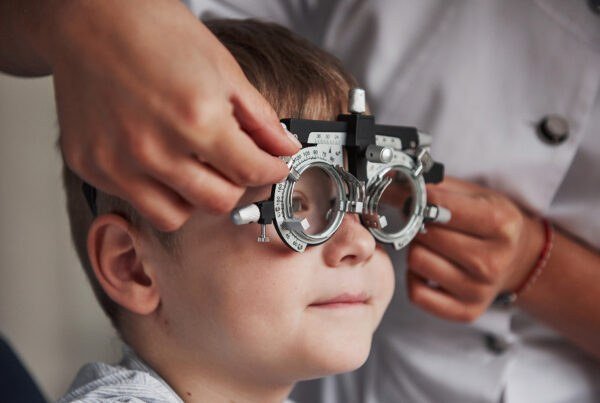
It is free, painless and far less demanding than parents expect. The optician uses picture charts or matching games instead of letter charts for young children, and can assess vision objectively even if the child cannot answer reliably, using retinoscopy to measure how the eye focuses light. Eye drops that temporarily widen the pupil are sometimes used for an accurate prescription in young children; they sting briefly and blur near vision for a few hours. The optician also checks eye health and how the eyes work together. Afterwards you get a straightforward verdict: no problem, monitor and retest, or a prescription with an NHS voucher toward glasses. The whole thing usually takes about half an hour.
Glasses, vouchers and getting them worn
NHS optical vouchers cover the cost of basic children’s glasses in full at most opticians, with a range of free frames to choose from; you only pay if you pick designer frames or extras like thinning. Let your child choose their frames from the free range; a child who picked them will wear them. For sports, consider a strap or sports-specific pair, and ask about a spare pair for school, since lost and broken glasses are a childhood certainty. If your child resists wearing them, tie glasses to the activities they improve: reading, gaming, football. Praise the wearing, not the needing. And keep up the retests; children’s prescriptions change as they grow, and outdated glasses are barely better than none.
Screens, outdoors and the myopia question
You cannot give your child myopia by letting them read in dim light, but the modern environment is genuinely pushing short-sightedness up. The best-proven protective factor is time outdoors: around two hours of daylight a day is associated with slower myopia progression, and nobody fully knows why, though bright light and distance focusing both seem to help. The 20-20-20 rule is a decent habit for screen time: every 20 minutes, look 20 feet away for 20 seconds. Hold devices at a sensible distance rather than nose-to-screen. If myopia is progressing fast, ask the optician about myopia management options like specialist contact lenses or spectacle lenses designed to slow progression; the evidence is promising and growing.
The NHS Live Well hub has practical, evidence-based tips on diet, exercise and everyday health.
See also: How can i Look After my Mental Health During Dark Winter Months
The bottom line
Children do not complain about poor vision; they adapt, so watch for squinting, close viewing distances, headaches and school struggles. Sight tests are free on the NHS for under-16s with no referral needed, vouchers cover basic glasses, and early detection matters most for squints and lazy eye. When in doubt, book the test. It costs nothing and could change their school years. If you need a GP appointment, the NHS GP services guide explains how the system works.