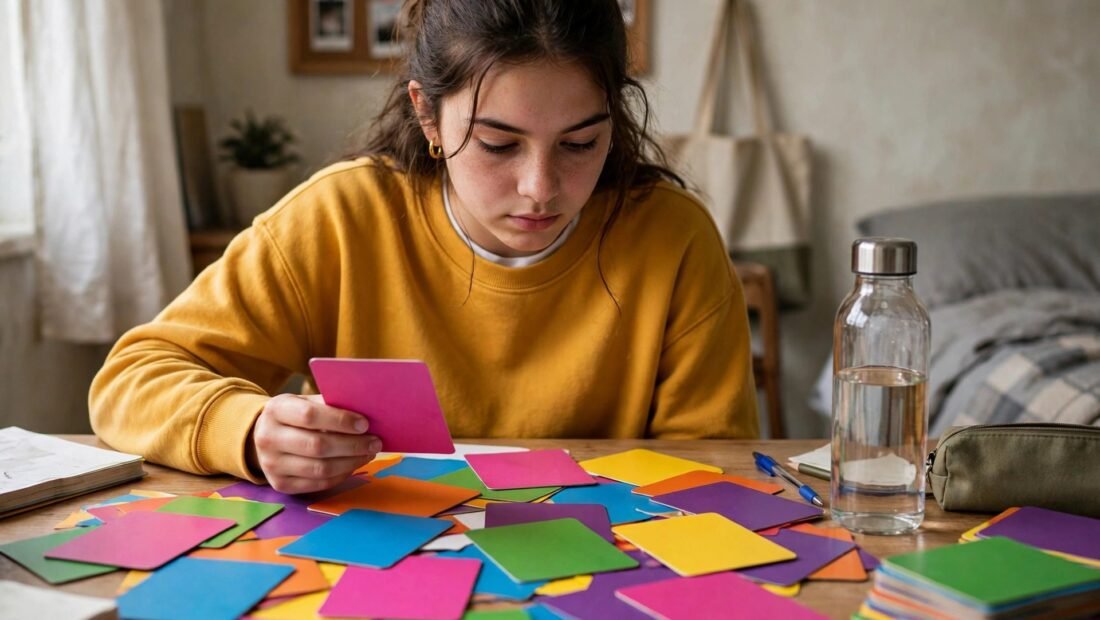
Ask a room of Year 11s how they revise and you will hear the same answers: reading through notes, highlighting textbooks, making beautiful mind maps that took longer than the learning they contain. These feel productive. The research says most of them barely work. Newcastle students face the same exams as everyone else, and the same revision myths.
Here are the biggest mistakes students make when revising for GCSEs, why each one fails, and the evidence-based methods to replace them with. Exam season is unforgiving of wasted effort; this guide makes sure yours counts.
Mistake 1: Re-reading Notes and Highlighting
Re-reading feels like learning because the material becomes familiar. But familiarity is not recall, and exams test recall. Highlighting is worse: it creates the illusion of engagement while the brain coasts. Study after study ranks re-reading and highlighting among the least effective revision techniques known.
Replace both with active recall: close the book and write down everything you remember, then check. Flashcards, blurting, and past-paper questions under timed conditions all force retrieval, which is what builds durable memory. It feels harder, which is exactly why it works. The discomfort of not remembering is the feeling of learning happening.
Mistake 2: Revising Everything Equally
Students naturally revise what they already know, because it feels good, and avoid weak topics, because they feel bad. The result is polished knowledge of the easy stuff and gaping holes where the marks actually are. Examiners do not award marks for confidence; they award them for correct answers on the whole specification.
Audit ruthlessly. Print the specification for each subject, rate every topic red, amber or green, and spend most time turning reds to ambers. Past papers reveal the pattern: topics you consistently lose marks on are your highest-value revision targets. An hour fixing a red topic earns more marks than an hour polishing a green one, every time.
Mistake 3: Marathon Sessions and All-Nighters
The six-hour Sunday revision marathon produces about two hours of actual learning and four hours of glazed staring. Attention degrades, memory consolidation needs breaks, and sleep-deprived brains cannot form the memories the exam requires. All-nighters before exams are actively counterproductive: you sacrifice the sleep in which memories consolidate for extra cramming the tired brain cannot retain.
Work in focused blocks of 25 to 50 minutes with real breaks, and protect sleep fiercely in exam season. Eight hours beats six for memory, and the difference shows in results. Revision timetables should schedule rest, exercise and downtime as non-negotiable entries, not leftovers. A rested brain with six hours of focused revision outperforms an exhausted one with twelve.
Mistake 4: Beautiful Notes Instead of Testing
The perfectly colour-coded mind map, the Instagram-worthy summary sheet: these consume hours and produce artefacts, not knowledge. Note-making feels like revision because it is effortful, but the effort goes into design, not memory. Many students discover too late that they can reproduce their notes beautifully and answer exam questions badly.
Make notes once, briefly, then switch to testing. The gold standard is past papers under exam conditions: timed, no notes, marked harshly against the mark scheme. Aim to complete every available past paper for each subject, since exam boards reuse question styles relentlessly. AQA exam board publishes past papers and mark schemes free; learning the mark scheme's language is itself high-value revision. BBC Bitesize covers every subject with grade-relevant content for the studying itself.
Mistake 5: Ignoring the Exam Technique Half of Marks
Knowing the content is only half the battle. GCSEs reward exam technique: command words, timing, structure, and showing working. Students lose shocking numbers of marks by misreading questions, writing everything they know instead of answering what was asked, and running out of time on high-mark questions.
Learn what describe, explain, evaluate and discuss actually demand, since each wants a different answer structure. Practise timing: in a 90-minute paper with 80 marks, that is barely over a minute per mark, so a 6-mark question gets 7 minutes maximum. And always show working in maths and science: method marks rescue wrong answers. Teachers will confirm that technique, not knowledge, separates grades at the top end. how teachers feel about students using AI for homework reflects how teachers view the shortcuts students try instead.
Mistake 6: Starting Too Late and Cramming
The Easter holidays are when serious revision should be underway, not when it starts. Cramming compresses learning into a window too short for memory consolidation, and it spikes stress to levels that impair performance. The students who seem calm in May started in February.
The fix is spaced repetition: short, regular sessions spread over months beat intensive bursts. Even from a late start, spacing what remains helps: three 40-minute sessions across three days beat one two-hour session. Build a realistic timetable working backwards from each exam date, front-loading the weakest subjects, and treat it like a part-time job. Consistency compounds; panic does not.
Newcastle-Specific Support Worth Using
Newcastle's libraries offer free, quiet study space with long opening hours in exam season, a genuine alternative if home is distracting. Many schools run Easter and half-term revision schools: attend them, since structured, teacher-led sessions on weak topics are among the highest-value hours available. Ask teachers for predicted-paper walkthroughs and intervention sessions; they would rather help now than console in August.
Study with others selectively. Group revision works for testing each other and explaining concepts, since teaching is the ultimate active recall, but dissolves into socialising without structure. Set an agenda: 40 minutes of past-paper questions, then 20 minutes comparing answers. And keep perspective: best budget laptops for students under £500 matters more than students think, since a dying laptop in May is a crisis no timetable survives.
The Final 48 Hours Before Each Exam
The last two days before an exam have their own rules, and most students get them wrong. Forty-eight hours out, stop learning new material entirely; the consolidation window has closed, and new content now only creates anxiety. Switch to light review of what you know: condensed notes, flashcards of key facts, and one final timed past paper if you have any left, marked and learned from.
The day before, keep it short: two to three hours maximum of gentle review, then stop. Exercise, eat properly, and prepare everything for the morning, equipment, water, timing, route, so the exam day has no friction. Sleep is the highest-value revision available: eight hours beats any amount of late cramming, because memory consolidation happens during sleep. On the morning, eat a real breakfast, arrive early but not so early you absorb others' panic, and avoid the pre-exam huddle where classmates compete to sound knowledgeable. In the exam, read every question twice, plan longer answers briefly, and keep an eye on the clock from the start. You have done the work; the final 48 hours are about delivering it.
GCSE revision fails in predictable ways: re-reading instead of recalling, polishing strengths instead of fixing weaknesses, marathoning instead of spacing, beautifying notes instead of testing, ignoring technique, and starting too late. Replace each with its evidence-based opposite and the same hours produce dramatically more marks. The exams reward effective effort, not just effort. Make yours count.
Frequently Asked Questions
What is the most effective GCSE revision method?
Active recall through past papers under timed conditions, combined with spaced repetition over months. Testing yourself from memory builds far stronger retention than re-reading or highlighting.
How many hours a day should I revise for GCSEs?
Quality beats quantity: 3 to 5 hours of focused revision daily in the final months is plenty for most students. Work in 25 to 50-minute blocks with real breaks, and protect sleep.
When should I start revising for GCSEs?
Serious revision should be underway by February half-term at the latest, with lighter spaced review from Christmas. Starting at Easter leaves time only for cramming, which is far less effective.
Are mind maps good for GCSE revision?
As a one-time organising tool, fine. As the main revision method, poor: they consume hours producing artefacts rather than memories. Make them quickly, then switch to testing yourself on the content.